Can A Worksheet Do That? Teaching Social Studies in a Hands-On Way

We recently made the decision to pull my daughter from school and do “distance learning” for a short time because we had a new virus or sickness in our home every week and it wasn’t sustainable anymore (more on that story to come later). 

Luckily, the school was able to work with us to make her a “distance learner” because of Covid protocols still in place, instead of unenrolling and re-enrolling her when she’s ready to head back. 

She is in kindergarten, so the workload is fairly easy and somewhat hands-on. However, one worksheet for social studies looked like this: 
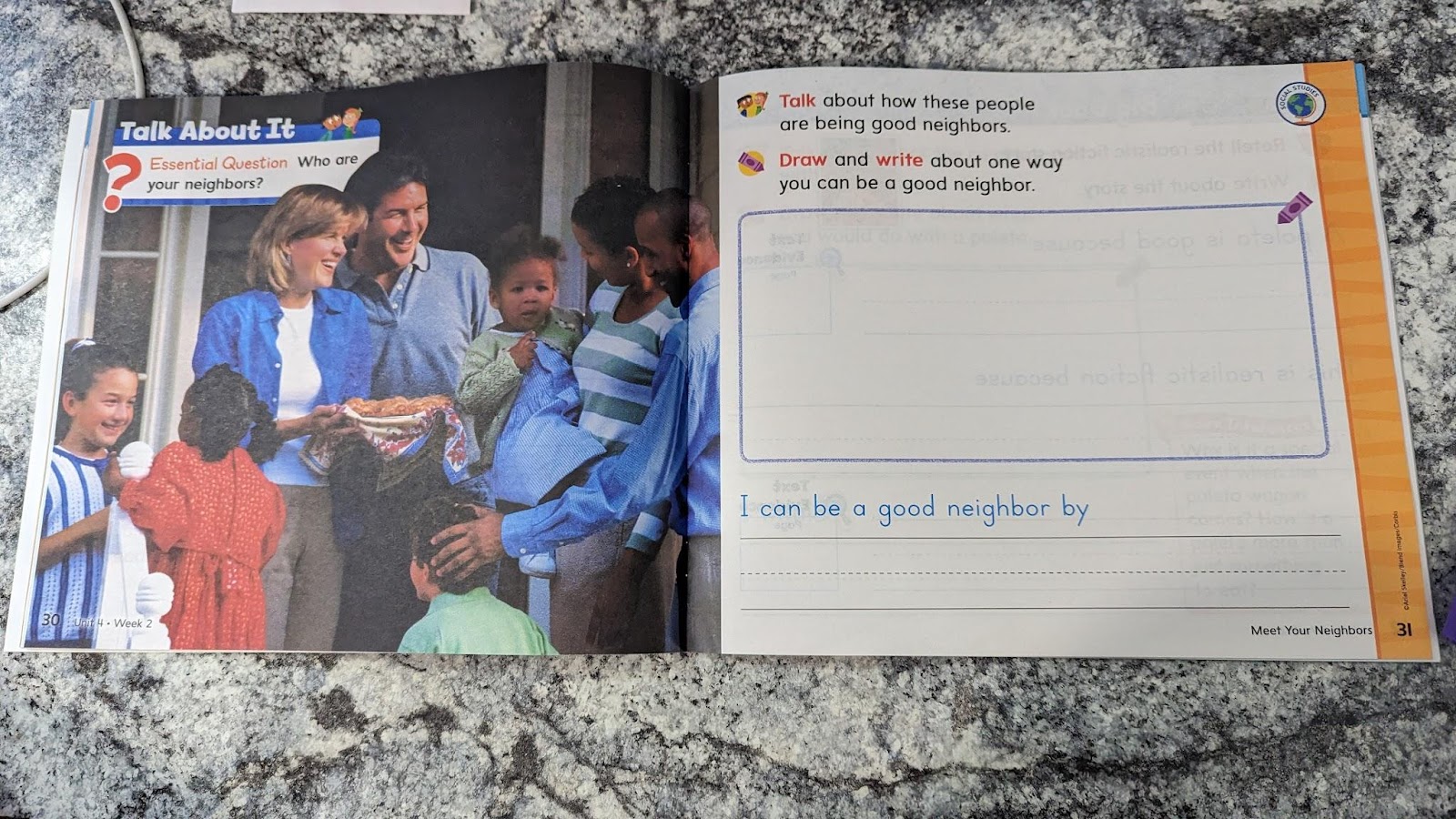
Photo: A group of neighbors with adults and children standing around, laughing, and talking. Food is being exchanged. 

Text on photo: Talk About It: Essential Question. Who are your neighbors? 

Text: Talk about how these people are being good neighbors. Draw and write about one way you can be a good neighbor. 

Writing prompt: I can be a good neighbor by 

I am sure this worksheet sparks great conversations in classrooms and it gives the students a chance to draw and write about what they’re talking about. 

The only requirement for my daughter was to do everything this page said. Talk about it, write about it, and draw a picture. Then she would have been done with the assignment and moved on. 

But what did she learn from that interaction? 

Are we really learning social studies with this worksheet, or are we learning conversation skills, writing, and drawing? 

How can we do this… better? 

We started with a picture book.
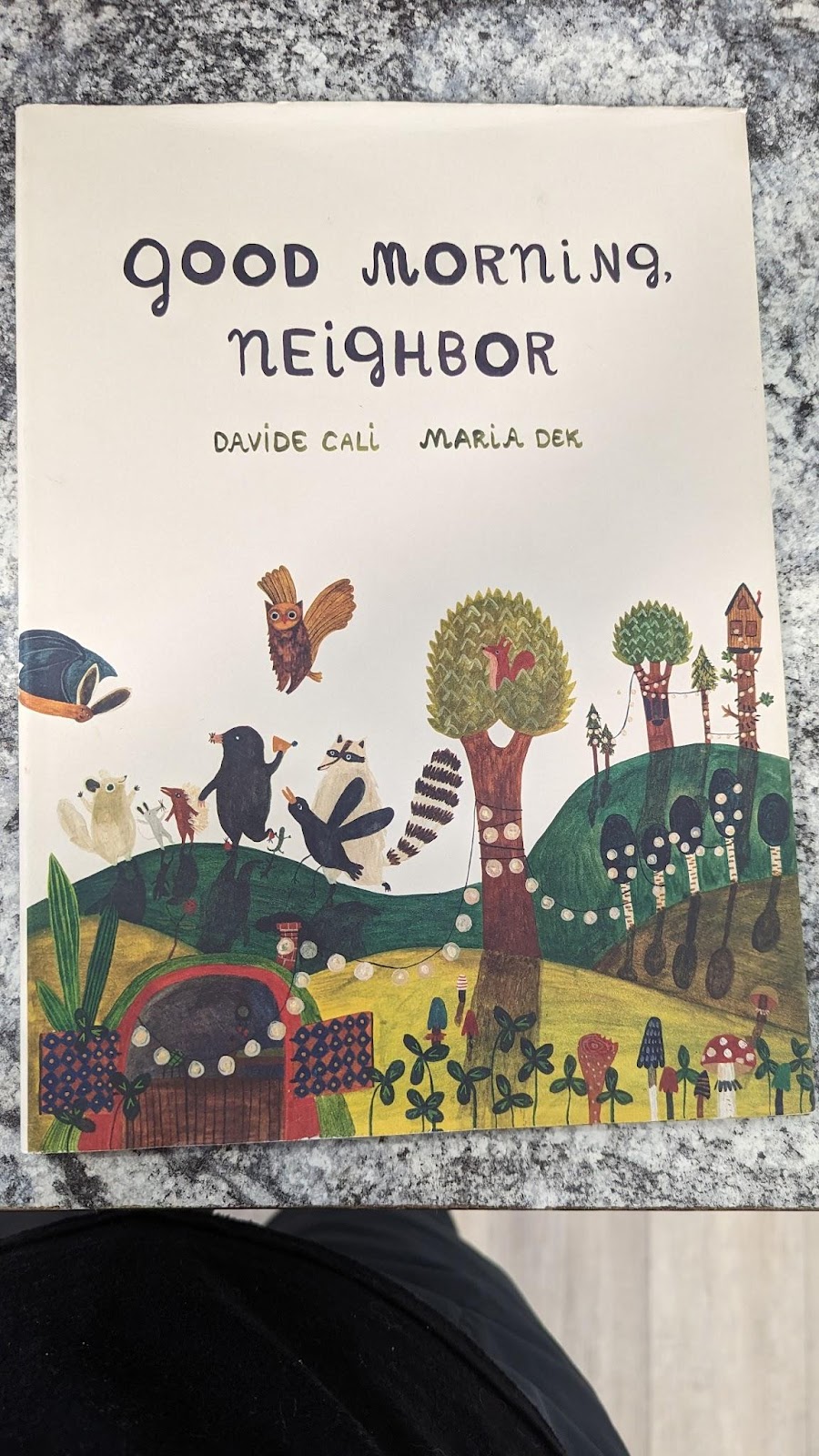
Good Morning Neighbor by Davide Cali and Maria Dek 

I highly recommend keeping this one in your personal library, it’s a good one with many applications. 

After reading the book, the discussion started.

Who are our neighbors? What nice things have they done for us? What nice things have we done for them? Why is it important to be a good neighbor? 

And then we took it one step further, what can we do for one of our neighbors today?

This led us to making and delivering dinner and cookies for a neighbor that we knew was sick. We also stopped next door to an elderly widow and chatted with her for a while, asking her if she needed anything. On our way out, we quickly shoveled her driveway and cleared her car of snow and ice. 

On our walk home, we noticed that another neighbor near us had some rugs left outside on their doorstep that had blown into the yard from the high winds. We spent a few minutes gathering them up and stacking them on the doorstep since they were not home to take them inside. 

Once we were finally home, we pulled out the worksheet, and my daughter felt like she was ready to write a whole paper on ways she could be a good neighbor. She wanted to give the full story of everything we accomplished in our afternoon of service. Instead, we settled on a simple few-word sentence, and then she was able to tell her teacher the whole story the next time we went into the school to bring back her finished schoolwork. 

Looking at it overall, how much would she have taken away if we would have had the discussion and written the sentence? She would have practice in writing, that’s for sure. But the whole point was to focus on social studies. What did she take away from a social studies standpoint? 

She would probably know that she needs to be a good neighbor. And maybe have some ideas on how she can be that will stick around in her mind for a few weeks, maybe up to a month. Nothing would stick around long-term. 

But after spending an hour serving our own neighbors, the lesson will engrain itself in her mind more than a light discussion and sentence writing ever would. 

Now I know delivering dinner and sitting down to an afternoon chat with everyone’s neighbor isn’t doable in a full classroom. So what can we do in a classroom of 25+ students to give them a similar experience? 

Talk about neighbors within the classroom. Our neighbors in a classroom are our friends sitting by us, but all together, we are a full community. Discuss ways we can be a good neighbor within our own classroom. 

Give them opportunities to draw pictures or notes for their neighbors. Maybe create crafts or pick treats for their neighbors. Let them practice helping their neighbor when zipping up coats to go outside, or picking up trash around their desk during messy play. 

If you’re creating an uplifting, teamwork environment in the small community of your classroom, it will eventually translate itself into their daily life and show in small ways around the school and in their neighborhoods.

Can filling out a worksheet accomplish that? 

Photo by Katerina Holmes

Anna Crabb- Advocacy For Childhood

This post is part of a series where we interview real educators and tell their direct stories. All words are their own. You can see the entire series here. 

“My degree is in human development, but I knew I wanted to be in education. I was hesitant to go down the education route because there were some things in public schools that I didn’t enjoy as a child. So I ultimately decided not to get an education degree, but hoped somehow, some way I could still be involved in education, but I truly did not know what that would look like.”

“My first glimpse into alternative education was Montessori. I had randomly heard about it and looked up jobs while I was still in undergrad and ended up finding somewhere that was hiring. I was loosely trained by the owner and I loved it, so I dove really deep into the Montessori world for a few years and finished my degree in human development. I thought I was going to go full-blown Montessori, but then we moved and I didn’t like any of the Montessori schools in our new area. They seemed too aggressive and rigid.”

“I stumbled on an ad for an alternative education school opening up in the fall that was still looking for guides, so I applied and got the job. I ended up using Montessori a lot there, but they wanted me to also keep it more open-ended. I worked there for a year and started their early childhood center, which was a pivotal experience for the school I eventually opened myself.”

“We moved again and I was very much missing teaching. When it came time for my oldest to start school, I could not find a school that felt like my style. It felt like the only thing they were talking about and advocating for was kindergarten readiness, they weren’t talking about anything else other than kindergarten readiness, and it felt very braggy, like, “look how fast we can get your kids to read!” and, “look how fast we can get your kids to count to twenty!”

“That just says to me that they don’t see or appreciate or value childhood. What pushed me over the edge was when I watched a documentary that was all about how education can look different. After that, I had a whole moment where I thought, “I have to start a school! I have to do this myself!”

“I had nine months to get my school ready, so I just dove right in. I ended up combining my experience with Montessori and the curriculum of a previous school I was working at, as well as some training I had started with Reggio Emilia. I’ve blended all of these resources as well as my background in human development to give my school its foundation.” 

“The beauty of it is in the environment. It’s in the way I set up the space. It’s all free choice and child-directed, there is minimal direct teacher instruction. That enables them to work at their own pace and choose to work on things that they’re interested in, and allows me to float around and help as needed. All of the materials are child-directed with a control of error built in so they can teach themselves. There is a clear right or wrong and they don’t need me to tell them, which is nice because then they don’t develop that dependency on another person to tell them if they’re good or not, they can have their own experience. It’s this personal, intrinsic experience versus a co-dependency on other people to validate them.”

“It’s definitely a lot of trusting the process and if they’re really into one thing for many weeks and they don’t even touch math, you let them do that and trust that eventually you can integrate those math scenarios into real-life situations so they can see how that skill might benefit them. They work with these materials independently and they might work with me, and I give them these real-life experiences to help them get excited about learning whatever skill they need to learn. Or maybe I would work in small groups as well to help give them the social keys needed. It is fluid, it’s child-directed, it’s play-based, and it’s all hands-on.”

“It really does come from this place where I want to advocate for kids. Now that I’m in this space I can never go back. Whenever I see things that are common in other schools that are dismissive of childhood, I want to fight for them and fight for the kids, the parents, and the teachers. I just want to tell them, “It doesn’t have to be this way! It can be easier,  happier, and more natural, and the kids can actually enjoy learning!” That really is the underlying theme of all of it- advocacy for childhood.”

A day in the life at Stoneybrook Hollow

To the Parents Newly Entering the School System: You’ve Got This

I spent many years going to school to become a teacher. More specifically, a public school teacher. I wasn’t opposed to private or charter schools, but I did feel more of a draw for public schools. Maybe because that was my school experience, so that’s what I felt the most comfortable with? 

During my undergrad, I was able to spend time in around 5 different public schools and 1 public charter school in the Cache Valley, Utah area. It gave me a good look into the amazing, the good, the bad, and the ugly of our public school systems. 

When it came time to register my oldest for kindergarten, I was excited for her to start in a public school that I felt so drawn to! (For the record, I was open to her attending private or charter, but it’s not a feasible option in our current location.) We walked into the halls of the school on a mid-May day and could hear students practicing songs for their end-of-the-year program. We could physically feel the spring itch everyone had, ready for school to be out for the year so that summer vacation could officially commence. It made me so excited! We took the registration papers from the front desk, filled them out, and received all of the information we needed to know about the first day of school in the fall. 

The summer went on with constant excitement and conversation about starting school. I realized that as the day came closer and closer, the more nervous I felt. I tried not to let this show to my daughter, she was just one giant ball of excitement, and I knew if my nerves were showing, she would take them on herself, and that was something neither of us needed. 

Our school allowed parents to request teachers, but we were new to this town we were in and didn’t even have anyone we could ask for their opinions on which teacher to request! I assumed all four kindergarten teachers were probably amazing because it really takes an amazing human being to choose the profession of a kinder teacher. But when it came down to it, the reason I had so much anxiety about sending my daughter to school was the amount of control I had to give up as a parent. 

I’ve tried really hard not to be a helicopter mom to my kids and allow them as much independence as possible, which can sometimes be hard to do when you just want what’s best, easiest, and safest for your kids! However, research article after research article will tell you how important it is for children to have independence, opportunities for decision-making, and even moments of failure or risk. 

What ended up being the hard part for me was the fact that I had complete control over who was taking care of my children at any given time in their lives. Anytime we had babysitters, extra help with our kids, had to leave them overnight for something, or even just child care during work hours, I was always able to have a very large choice in the matter. When we chose a daycare for our kids, I took the time to tour and interview various daycares near us to choose which one I felt most comfortable sending my kids to. 

When it came time for my oldest to start public school, it wasn’t a matter of “tour various locations and interview many people to make the best possible decision.” It was a matter of, “This is where the boundaries say your child should go to school, so this is where you will go. Furthermore, we will assign teachers to the students.” 

Okay, it wasn’t that harsh. A lot of school districts will allow you to change schools and/or districts if you go through all of the right steps and paperwork. And they did allow requests for teachers. 

But in a large way, I really did feel like I was giving up so much of my voice and control over who my child spends time with and what she is exposed to all day every day by sending her to public school. It was daunting and anxiety-inducing. 

However, we are almost three months into it, and I’m realizing that it’s okay. 

It’s okay for her to be around a good diversity of safe adults within a public school. 

It’s okay for her to choose who to play with at recess. 

It’s okay for her to choose not to eat her lunch sometimes. 

It’s okay for her to grow and develop a relationship with her teacher, even if I didn’t handpick that teacher. 

So to all you parents that are new to any school system. Yes, even those that homeschooled for years and years and made the jump out of homeschooling and into public, private, or charter school. 

I see you. 

It’s hard and overwhelming to make this huge adjustment to your life. It’s overwhelming how many decisions are being made that you just cannot be a part of. It can be fearful to wonder what happens in those school hallways for all of those hours that you’re not there with your child, especially if you’ve been accustomed to staying home all day or most of the day with them. 

But it’s also so, so good. For both of you. And it’s okay for both feelings to exist at the same time. You’ve got this. 

Photo by Vlad Vasnetsov

Sight Word Games For the Early Reader in Your Life

With my oldest in kindergarten this year, sight words have become a big part of our daily life. She’s practicing them at school and then we have a list at home that we can work on as well. And as I’ve written time and time again, “Play is a child’s work.” So we don’t just buzz through sight word flashcards as fast as we can, we use sight words in our play. Here are a few games we’ve come up with together to help along the way. 

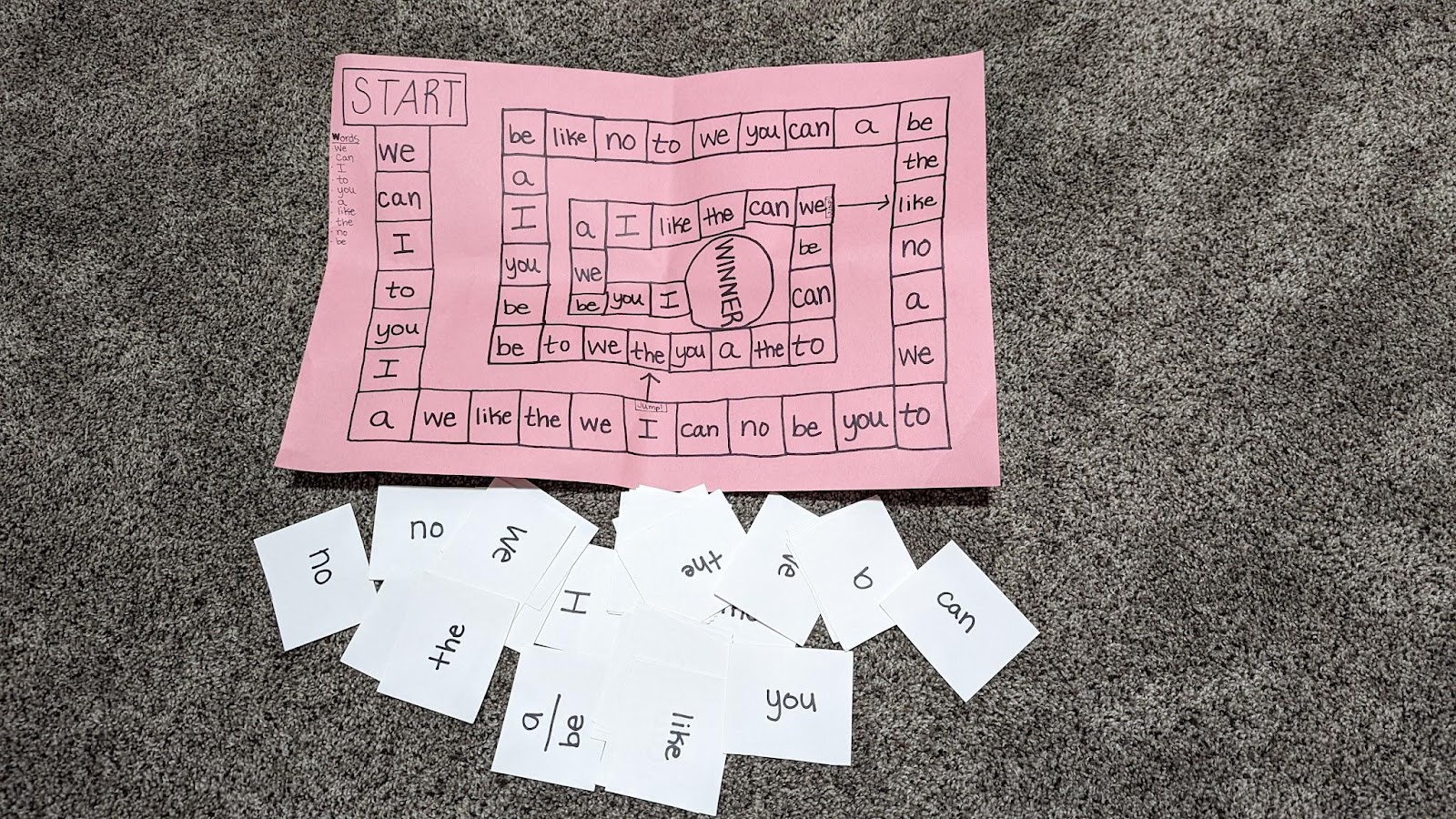
Sight word board game: My daughter and I made this game together in a similar way to how you would play Candyland. There are two ways you can play it- make your own cards with sight words written on them to indicate where your next square is. Or, roll the dice, move forward that many spaces, and read the words as you move. For pieces, we use Bingo tokens, various board game pieces, or small toys. Yes, Skye and Chase help us play this game! If you know, you know!

Sight word Jenga: We bought a few of these tiny tumbling tower sets from Dollar Tree and wrote various sight words on them. Once we pull a brick out, we read the word, and once the tower has tumbled, we take turns making sentences with the words we pulled. We did multiple sets so we could add in more sight words as they learn them in class. I plan to do CVC and CVC-e words someday when she’s ready for that. 

Sight word sentence builder: I bought a pack of sight word flash cards for cheap on Amazon to save me the time and effort of making my own. We use these cards, plus a few index cards with words we decide to add, to create fun sentences. We also use our Jenga blocks for this as well! This one is my daughter’s favorite way to play with sight words! 

Sight word seek and find: For this, we use our sight word flashcards, or sometimes I’ll write them out on sticky notes and use those instead. One of us hides the sight words and then the other one finds them while reading out which word they found. Pictured here is your classic “hide it in the Christmas tree” move. The amount of random toys I pull out of our Christmas tree at the end of the holiday from various hide-and-seek games is unreal!

Sight word seek and find + builder: This game is a two-part game! I place sticky notes with letters throughout our family room, then she is required to find the letters and build the sight words out of the letters. This one took some scaffolding. In the beginning, it was just a letter here or there omitted in sight words that she had to find, but as she got better and better at it, she started spelling her own words with less prompting. 

Sight word hopscotch: This one can be as intricate or as easy as your time and energy allow. We’ve done this quickly outside with sidewalk chalk, quickly inside with our flashcards, or intricately with painter’s tape boxes taped out on the floor or full sheets of paper with the words written on them taped to the floor. SO many different ways to do this one! While jumping from square to square, we read the words. 

Sight word beanbag toss: This one is a simple one we like to do in addition to the other games we’ve been playing. I simply just lay the flashcards out on the floor and my daughter takes a beanbag (or a soft toy, stuffed animal, etc.), tosses it at a card, and if it’s touching the card she reads the word, then she is handed the card. If she doesn’t read the word correctly, she tries again!


Not only are these sight word games building awareness of words, but they are also utilizing fine and gross motor skills, moving around the room, and using, deconstructing, and building these words in ways they haven’t before. Learning sight words isn’t reading. It’s memorizing. And play is a child’s work, so in order to work through memorizing these words, they must play. 

What sight word games would you add to this list? 

Delaying Kindergarten for Boys? Does it Make a Significant Difference?

I’ve written quite a few posts on here about decisions centered around kindergarten, more particularly on when to send kids to kindergarten. There is so much research out there on what to do, especially for those late summer birthday kiddos. 

My second child is in a similar boat as my first, his birthday is in early August so he is right around the Sept. 1st deadline for starting school as well. If we were to send him to kindergarten when he is supposedly supposed to go according to these guidelines, he would turn 5 years old and then head to his first day of kindergarten just two weeks later. Some kids thrive under these conditions- i.e., my firstborn! For others, this sounds like an absolute trainwreck- i.e., my secondborn. 

We still struggled with the decision for a while, though. 

During our research, my husband and I ended up reading the book Boys Adrift by Leonard Sax, a great book full of advice for raising boys in the modern world. In the chapter about starting school, Leonard talks a lot about a study done on brain scans of male and female brains over the period of many years and the findings they had on how a male brain develops vs. how a female brain develops. When it comes to the part of the brain that has to do with attention span, reading, writing, etc., they found that the male and female brains develop at the same pace, but the male brain is roughly two years behind the female brain in this development. 

He is clear that this does not mean that one is smarter than the other, it just means they are different in how they develop. In regards to boys starting kindergarten he states, 

“Trying to teach five-year-old boys to learn to read and write may be just as inappropriate as it would be to try to teach three-year-old girls to read and write. Timing is everything, in education as in many other fields. It’s not enough to teach well. You have to teach well to kids who are ready to learn, kids who are developmentally “ripe” for learning. Asking five-year-old boys to learn to read- when they’d rather be running around or playing games- may be the worst possible introduction to school, at least for some boys.” 

He continues on with the subject and even states that more often than not, you’ll see the majority of boys starting kindergarten at six years old because parents are seeing the benefit of this “gap year” in their sons. 

This research seemed very interesting to me and in observing my own children, it made sense. At three years old my daughter was ready and eager to learn letters and numbers and how to write. At 3.5 years old, my son wants absolutely nothing to do with them and I am doing my best not to push anything on him until he is ready. 

What are your thoughts on sending kids to kindergarten a year later and giving them a gap year? Do you think gender, birth order, or other factors play into the decision? 

Cover photo from pexels.com

A Kindergarten Decision

A while back I wrote a post about struggling with the decision of sending my late-summer birthday child to kindergarten this year, or holding her back for a year and waiting until she was a little older and more mature. 

My husband and I went back and forth on this decision for basically five years. No, I’m not even being dramatic about that, it really was something that from the time she was born until the day I sent her to her first day of school, we were going back and forth about when the right time was to send her. Ultimately, we came to the conclusion that she would start kindergarten this year, the year she was technically supposed to start, not a year late. 

The majority of this decision was intuitive. We did look at research and listened to advice from friends and neighbors that had been in similar circumstances, but at the end of the day, we made a decision for what felt best for her specifically. In fact, a lot of the research you read online leans towards sending kids to kindergarten later/ when they are older, but ultimately it didn’t feel right for her. 

We even had a curveball thrown at us because initially, we were living in a school district with half-day kindergarten and plenty of familiar friends that would be in class with her so it felt safer. But through a turn of events, we ended up moving to a different school district and even a different state. The elementary school in our new location is full-day kindergarten, 4-day school weeks, and because of moving, no familiar faces. 

You would think it would be plenty of reason to delay kinder one year to give her and us time to make friends and time for her to grow and become comfortable in her new environment. However, at the end of the day, we still felt like we were making the right decision. I was nervous through the whole process, constantly wondering if we were making the right call. 

The first day of kindergarten came and walking her through the hallways of this new, big school, I still had the thought, “I could take her home right now. I can still put school off for another year. She doesn’t have to go to school right now.” Yet still, we put one foot in front of the other, and we were both as brave as we could be as we walked into that new classroom with a backpack full of crayons and pencils inside of her clear pencil box decorated with princess stickers. 

Okay, let’s be honest here. My daughter walked into that classroom as confident and excited as can be. I, on the other hand, was the one trying to put on a brave face. 

Even after leaving her at the school, walking out the doors, and calling my husband with a shaky voice on the verge of tears, I stood by my gut instinct that was telling me it was time for her to go to school. It was incredibly hard to have my brain, my heart, and my instincts all pulling me in different ways, where ultimately, all of them were the right decision. 

After the first week of school, I started feeling really good about our decision. And after a few months of school when we attended our first parent-teacher conferences, I approached my daughter’s teacher about the subject. I told her about our internal struggle of sending her this year to school or waiting until next year and was wondering how she was doing overall, not just how she was doing on her test scores. 

What she said next has stuck with me and helped me on the days that I doubt myself. She said, “You couldn’t have made a better decision for her. She is absolutely thriving in this classroom. She fits in so well with her peers, even if a lot of them are quite a bit older than her. Had you waited until next year, I don’t think she would have felt so at home and fit in as well. She would have been significantly older and struggled with friendships. And academically, she’s right where she needs to be.” 

You couldn’t have made a better decision for her. She is absolutely thriving in this classroom.

This was the validation I needed. I felt massive amounts of confidence after hearing this from her teacher. 

It was one of the hardest, more tearing decisions I’ve ever had to make for my kids, but I’m so happy I stuck with my gut and chose what she needed, regardless of what I wanted. 

Isn’t it wild that watching your kids get older and experience new things can be so sad and so incredible at the same time?

Do You Also Hyper-Focus On Your Child’s Ability To Retain Rote Memorization?

The pressure of learning in early childhood is real and unnecessary. I’ve written articles on this exact topic and I’ve done my own research on it as well! But still… it’s real. It’s there. The ideology that children should be able to name colors, shapes, numbers, letters and more all before Kindergarten seems wild and academic-minded instead of development-minded. However, even I have fallen into the trap of this thought process!

We were wrestling with the decision of sending my daughter to Kindergarten the year she met the cut-off or holding her back one year. The idea of sending her the year-earlier came up and my first questions were,

Does she know all of her letters though?
I know for a fact that she doesn’t know all of their sounds yet.
She’s pretty good at the numbers 1-10, but what about 11+?
How is she supposed to be reading if she doesn’t know her letter sounds?

I quickly fell into the trap of “kindergarten readiness” and thought that my daughter wasn’t going to be ready in time because she didn’t know enough yet. Also, it’s important to keep in mind that it’s currently November 2021 and she won’t even start kinder until September 2022!!

Once I took a deep breath and realized what I was doing, I pulled up an old post that Mary write about kindergarten prep and a list of what you truly should be focused on when deciding if a child is ready for school or not:

  • Feel capable and confident, and tackle new demands with an “I can do it” attitude.
    Check.
  • Have an open, curious attitude toward new experiences
    Absolutley she does.
  • Enjoy being with other children.
    YES. It fuels her extroverted soul.
  • Can establish a trusting relationship with adults other than parents.
    Check. Again, I’ve got an extrovert on my hands.
  • Can engage in physical activity such as walk, run, climb (children with handicaps can have a fine time in kindergarten if school and parents work cooperatively on necessary special arrangements).
    All day every day.
  • Take care of their own basic needs, such as dressing, eating, and toileting.
    The most independent soul I know.
  • Have had experience with small toys, such as puzzles and crayons.
    Yes.
  • Express themselves clearly in conversation.
    Yes, well enough for a 4 year old.
  • Understand that symbols (such as a stop sign) are used to provide useful information.
    Check.
  • Love books, stories and songs and can sit still to listen.
    Oh, yes.

So when you also inevitably find yourself getting caught up with your child’s knowledge on rote memorization (yes, that’s all learning letters, shapes, etc is.), take a deep breath. Realize that it’s normal to have this thought process, but there is more to it. And then come back to this list and remember the important things that your child really needs to know when they go to school.