This winter has proven to be particularly hard for parents everywhere while we are trying to entertain our kids during these cold months without the aid of indoor playgrounds/ activities that we’ve had in the past. Being stuck inside all day can be so hard to get those gross motor skills working!
While I am a big supporter of outdoor play in the winter, there is still a need for good, safe, gross motor play in the home. Here are a few of the ideas that have kept us sane.
Indoor obstacle course: I just add painters tape X’s on the ground for my kids to jump on, our kitchen bench to crawl over or under. Utilize your stairs in the obstacle course if you can! Tape papers on the walls for them to high five, stools to jump off of, and more!
Grab some plastic cups: set up either like bowling bins OR in a pyramid and roll a ball at them. Watch the “crash!” and set them up again! Don’t worry about having to set it up over and over again, that’s a great job for your kiddos to get in on.
Practice some tumbling: Show them how to do somersaults, cartwheels, handstands, and more. There are videos on YouTube for kids to practice as well!
Dance party: Get up and moving with a dance party! Throw on your favorite music and get everyone moving.
Wastebasket Basketball: Crumple up some paper and shoot it into the garbage or recycling bin. You could also challenge them to search around for pieces of trash around the house to toss in. Cleaner house, fun activity, everyone wins!
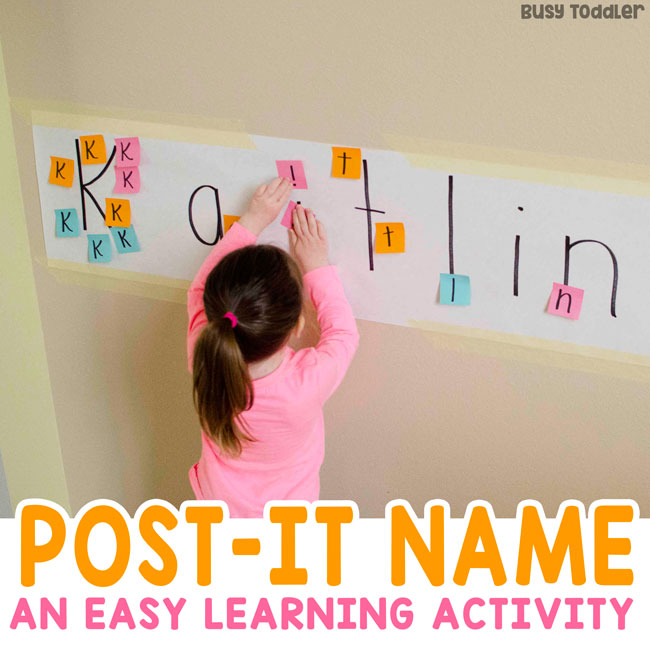
Sticky note find: this is one that is hard to describe without a picture, so I had to borrow this one from Busy Toddler’s website. Hide the sticky notes around the house and have them run around finding the sticky notes and running back to organize it where it goes! We’ve done this with colors, shapes, numbers, letters, or even just pictures!
Treasure Hunt: Grab a clipboard and a piece of paper and draw pictures of objects around the house for your littles to find. Once they find them, they can color it in, put a checkmark over it, or if accessible, have them take a camera or phone around taking pictures of their findings!
Paint in the bathtub: painting is typically a fine motor skill. But once it’s moved to the tub, it can become a gross motor skill! When the shower walls become your canvas, movement is inevitable, they’ll be using their arms to paint, not just their hands. Also the biggest bonus: easy cleanup! You can buy specifically bathtub paints, or I’ve found that regular washable paint does fairly well too. Use your best judgment.
Painters tape road: lay down some painter’s tape for “roads” throughout your home for your kiddos to drive cards on them. The biggest success with this is- make them go throughout your home. This is how you’ll get them moving! Keeping the tape in one congregated area of the playroom will keep the kids there too. Have the roads weave through the bedrooms and hallways, getting them to move their cars all over! You can extend this activity by setting up houses out of blocks and creating a whole city throughout the entire house!
I’ve had a lot of conversations with friends lately about their preschool-aged kids and how the majority of preschool teachers are very focused on learning letters. They assign homework or make comments like, “Maybe work with your student on their letters at home, he seems to not be picking them up as fast as other kids.”
WHY.
Why are we so focused on kids learning letters and reading so early? Why are we adding to the stress and pressure moms feel? Why do we feel like walking away from preschool with every single letter memorized is our end goal here?
Let’s talk about other skills kids learn and walk away with from preschool that is even more important than letters and numbers.
Social skills- working with other children in play and at learning stations.
Language skills- walking away from school talking better and easier to understand.
Coping skills- how to handle emotions when mom and dad leave or someone takes a toy they wanted.
Responsibility with sensory bins, play dough, paint, toys, and other items.
Fine motor development- working through fine motor activities such as stickers or fingerpaint so later in life, they can do things like…. Hold a pencil.
Gross motor development- jumping and skipping and throwing.
Gaining a love and appreciation for literature.
Spatial awareness.
How to open snacks independently.
How to prepare food.
How to advocate for themselves.
How to communicate needs and wants.
Empathy and sympathy.
There is a list of OVER TEN things that preschool-age students walk away with that are essential to the future of their education, yet we are still focusing on learning letters and numbers. Yes, learning letters and numbers are important and we should focus on them as well! But it shouldn’t be our only spotlight. Play is a child’s work, it’s how they learn and grow. If we are giving them adequate time to play and interact with peers and adults, that’s what they need more than anything.
Please stop adding to the stress of parents and students by shoving numbers and letters down their throats! Please celebrate all of the accomplishments your child is achieving during preschool!
If you’re here you need some direction on how to start up sensory bins and other activities for the early childhood age! So before we begin, I want to share with you a whole page I’ve put together of multiple blog posts that can direct you and answer questions that you may have. Check it out here!
Adding in hands-on activities for your early childhood learners can be overwhelming at first, but don’t stress! I am here to help. What qualifies me? I was in the exact same position as you a few years ago. I had the desire to be the #teachermom that pulls out fun, educational activities for my kids, and even followed plenty of people on social media giving me all of the ideas for activities. BUT it seemed absolutely overwhelming to do so. Eventually, I got the hang of it, and now I am in a place where I can walk you through it! Here’s what I did.
I invested in materials. Typically, these materials are fairly inexpensive and you’ll probably find a lot of them around your home (rice, cooking utensils, paper, markers). But I found the most success when all of the materials were there and ready for me to pull out. I spent around $75 at Amazon, Walmart, and The Dollar Store combined. This is also partially because I didn’t want to share my kitchen materials with my kid’s activities, so I spent a good chunk on new spoons, cups, muffin tins, etc. Having all of the materials together and organized helped tremendously to help me feel like I could be a part of this crafty early childhood educator bandwagon of hands-on activities!
I lined out the purpose of these activities. Yes, I want my child to have these experiences and learning opportunities. But was I setting up activities for me to sit down and work with my kids one-on-one? Did I need the activities out to keep them entertained while I worked on something else? Yes to all of the above. However, it would take time to achieve the latter.
I decided to use the sensory bins and activities for one-on-one time and connection with my kids at first, and then eventually use them as something for them to do while I made dinner or worked. I wouldn’t be setting myself up for success by expecting my kids to play independently and keeping expectations of the activities.
I found the right social media accounts to follow. There are parents and educators out there that have done all of the dirty work for us! You don’t have to carefully create a new activity each time you feel your child needs entertainment or has a skill they need to practice. Others have already done it, and they are on social media! My favorites: Busy Toddler and Days with Gray.
These two stand out to me because they don’t post extravagant activities. It takes minimal set up time, simple materials, and are doable for any parent or educator to put together! Watch out for those social media accounts that are posting above and beyond activities that will make you feel inadequate to carry them out!
I made a schedule. This was a temporary thing that I didn’t have to do for long, but helped initially. It made it predictable for all of us and gave me a visual of what I could expect. I decided activities in the morning would be 1:1 and done with new activities that needed a lot of supervision. Afternoon activities, while I was cooking dinner, would be independent activities that I knew I could trust my kids alone with. It looked like this:
Week one: Activities in the morning after breakfast, before nap.
Monday: bubble foam Tuesday: rice scoop and transfer Wednesday: water painting on construction paper Thursday: Color mixing pour station Friday: contact paper art
Week two: morning activities for together time, afternoon activities for independent play
Monday morning: moon sand Tuesday afternoon: water painting on construction paper Wednesday morning: color mixing pour station Thursday afternoon: contact paper art Friday morning: dot sticker line-up/ color match
Week three: Start trying two activities a day!
Monday morning: moon sand Monday afternoon: sticky note shape match Tuesday morning: rice bin scoop and transfer Wednesday afternoon: water sensory bin Thursday morning: play dough Friday afternoon: dot sticker activity
This isn’t exactly but gives you an idea. Mornings were for working together and learning together. Afternoons were for independent play with materials I could trust my kids with. This schedule didn’t last forever, only about 3-4 weeks. But once I was in the rhythm and knew what to expect more, I didn’t need the schedule as much and slowly tapered off. Eventually pulling out activities became intuitive and I could tell when we needed one, what type it needed to be, and so forth.
Do what you feel comfortable with. Are you not into playdough or paint? THAT IS OKAY! You can still have success. Just because a teacher or mom on Instagram shows how “easy” and “doable” it is to let children play with slime doesn’t mean you have to do it too.
My first activities with my daughter were water sensory bins (because all it takes to clean up when it spills is a towel.) and “painting” with water on construction paper. Again, because cleaning up water is mounds easier than cleaning up rice.
Eventually, all of our water play led to me being more comfortable with dried corn in a sensory bin. Then rice. Then, I let my daughter paint… It was absolutely nerve-wracking, but guess what I learned? The paint can be cleaned up. I can clean it up, and my daughter can learn how to clean when she helps! “Everything can and will be cleaned up.” Now, years later, we paint at least once a week, and I can comfortably leave my 3.5-year-old alone at our kitchen table to play with play-dough. Rome wasn’t built in a day, friends.
Set you and your kids up for success. This is something that deserves a whole blog post, but I’m going to sum it up in two paragraphs for you. When setting up activities, think ahead. Are you working with paint? Keep a wet rag close by for messes. Maybe today is rice sensory bin day? Don’t put the bin near the fridge, because when it inevitably spills, it will roll under there and you won’t ever want to set up a rice sensory bin again. Also, set your kids up for success. No child was born knowing how to play properly in dried rice and corn, they need boundaries and rules! Keep it simple, but keep them there.
Don’t add too much rice, don’t give them access to too much paint, or too much water, etc. Use big blankets or dollar store table cloths and shower curtains to protect your floors. And know your exit plan. What will clean up look like? What will your child help with, and what will you take on? Read my whole list of sensory bin tips here.
I know, I know. This post can be just as overwhelming, if not more so than you were before. But take it in baby steps! Figure it out as you go! Your child isn’t looking for the perfectly curated bin with exactly the lessons and skills they need for their current age and stage.
Your child is looking for an opportunity to play. To spend time with you. To just be a kid. These finite details aren’t here to scare you away or add more to your plate, it’s just a reference guide for when you need help.
So let’s break it down to basics.
How do you start a rice sensory bin? Open a bag of rice. Pour contents into a large bin or bowl. Add in a cup and spoon. Sit on the floor with your child and enjoy.
It really is that simple. So, go play! Go have fun! And go let those kids explore!
But I can’t give you these blog posts about how much you shouldn’t be a helicopter parent without giving you an alternative. In fact, I needed an alternative way to parent myself! This is when my research led me to lighthouse parenting.
The whole concept of lighthouse parenting is that of a lighthouse- constant and always there. Keeping watch and being aware of your surroundings, but also respect the fact that kids can stumble and fall and learn lessons on their own.
“I like to think of myself as a lighthouse parent, you know reliably there, totally trustworthy, making sure he doesn’t crash against the rocks, but committed to letting him learn to ride the waves,” – Ginsburg
The whole idea of lighthouse parenting is that is it adaptable as your child grows and develops, your parenting grows and develops as well into what they need at that moment.
So for our children, our students, our future: Be a lighthouse parent. Let kids explore, let them learn and grow, but find a balance with keeping them safe.
But maybe we need to clarify the why behind these helicopter mom posts. Why is this a parenting style I am avoiding and trying to lean more toward independent kids?
A helicopter parent is someone who stands over their children making every decision for them and directing their lives. A lot of the motive behind a helicopter parent is to prevent their children from experiencing failure or getting hurt. However, doing so can actually do the opposite.
The side effects of being parented by a helicopter parent are depression, anxiety, low self-esteem, high stress, fear of failure, low self-confidence, and more. By never letting your child fail, you are sending the message that failure is not okay, therefore, bringing on all of the depression, stress, and anxiety that comes with the inevitable failure in life. This only grows more and more into adulthood.
To see more about the side effects of a helicopter parent, check out this video.
What does a helicopter parent look like in each stage of life?
As a toddler, it’s a parent standing right behind your child as they climb a ladder, even putting their hands and feet in the exact places they need to go to find success.
As a child, it looks like a parent changing their child’s teacher because they don’t seem to learn well with their current teacher.
As a teenager, it’s a parent that chooses which friends their children can spend time with.
As an adult, it looks like a parent that pushes certain colleges to attend (typically based on the closest location to home) and tells the child what the best area of study for them will be.
How can you change your parenting style to be less helicopter parent?
Step back and watch your child climb the ladder. Observe their method of movement and don’t step in unless absolutely necessary. Remember that a short tumble may be exactly what they need to learn the correct method for using the rungs.
Let your child stay in the classroom of this teacher, and give them ways to learn with the style the teacher is using. Teach them how to work with different personality types, then pull them out of the classroom if matters seem to be worsening and you have tried multiple approaches.
Have conversations with your child about the value of good friendships and what a lasting effect they can have in life. Teach them to identify good vs. bad friends and let them decipher their friend choices on their own.
Ask your child what their goals for their adult life look like, see what their ambitions and dreams are. Have conversations about what college looks like and means to them, and help guide them to whichever school seems to be the best fit for them.
By changing the way we interact and teach our children, it will lead to more independent and efficient leaders of tomorrow.
In the spirit of writing blog posts about independent children like I have been recently (you can read more of the posts here), I wanted to talk about one more way I’ve worked hard to give my kids independence and let them explore the world freely.
This time, it was with swim lessons. I placed my children in ISR (infant swim rescue) lessons at the ages of 10 months for my son and 2.5 years old for my daughter. They were both able to self-rescue and swim by themselves in the water after a few weeks of lessons. Here are some of the educational benefits I’ve found from placing them in these lessons, beyond just swimming and floating.
They learned they can do hard things. It’s hard to learn something so scary and different, especially in an environment like a swimming pool where you can feel so vulnerable. But once they mastered it and felt more confident in the water, they both realized that they worked hard to accomplish something really hard, and that’s absolutely worth noting. I saw them be less fearful and more willing to try hard things later.
They gained confidence in themselves.Because they learned something hard, they grew in confidence. Not only in the pool, but in other activities and learning environments.
They learned to problem solve. By practicing problem-solving in the water, I watched them apply it at the park on ladders and slides, at home in their play, and everywhere else they needed problem-solving skills.
They gained respect for water. They didn’t just learn how to swim and go run into any body of water they saw. They learned that water can be dangerous and fun, all at the same time. They learned to respect the nature of water and the consequences that can come with playing in it.
Giving my children the tools to be independent in the water without floaties or other swimming devices gave them more than just the ability to float on their back, it gave them multiple life lessons they will carry with them. It gave them another tool to grow into independent human beings, who are free to explore the world around them.
It was 4 pm and the TV in our basement was blaring. Almost in a daze as I made dinner, I tried to calculate how many hours of screen time my daughter had for that day.
“The entire movie of Frozen, plus four episodes of Mickey Mouse Club House. Or was it five episodes? Maybe this was episode six for the day…?” Regardless, I don’t know if the TV had ever actually been shut off, and for that, I was ashamed. I always thought I would be better at regulating screen time with my kids, but right then, I needed to make dinner, and keeping the TV on was the only way it was going to happen.
Now repeat this same situation for a week. Something needed to change, and soon.
I threw around the idea of TV time tokens with chores and such, but it felt like so much work that I wouldn’t actually follow through with it, and to get my husband on board seemed impossible. Simply saying “one episode and one movie a day” as we had in the past didn’t feel like it would work either, because here we were at this point, needing a new solution.
One day, I finally found our core problem. Who was addicted to the constant noise of the television? It wasn’t my daughter, even though she was the one watching it. It finally clicked in my brain that it was me who was addicted to screen time, not her. I was the one not wanting to take time to manage it and tell her no. It was easier for me to just tell her yes to Mickey Mouse and not deal with the fight of saying no, or the boredom that would follow if I didn’t allow it. She kept asking for shows because I kept letting her watch them. I needed to change.
Again, more and more brainstorming on the best way to manage the screens in our household ran through my mind before I found a solution. It needed to be easy and convenient because if it was too much work for myself, I knew I would cave.
It was about another week later when the solution hit me.
Let her manage her TV time by herself. Bam. It was that easy. With the proper settings in place, why couldn’t she? Why did I need one more thing to worry about as a mom?
Here’s what I did. (Please keep in mind, none of this is sponsored, it’s just what I chose to do/use).
We have an Amazon smart TV, which comes with a kid’s FreeTime app. On this app, I am able to set which TV apps my daughter has access to and how much screentime she is allowed. We gave her access to Disney+, PBS, and Netflix kids account. Considering that we were at 5+ hours of TV time a day, we set the time limit for 3 hours a day to see where that would get us.
Then came the time to teach her how to use the TV on her own. I spent time showing her the power button and how to use the navigation to move around to which app she wanted. I taught her how to specifically get into the FreeTime app and then navigate from there. And I explained how she only had so much time to watch her shows. Once the time was up, that’s all she had for the day, and would have to find something else to do.
One week of this in place and we never even hit the 3-hour time limit. I moved it down to 2 hours and occasionally she would hit her time limit. If she ever did, she would be sad for a minute, turn off the TV, and then find another way to occupy her time. We are now at a 1-hour 25-minute time limit for a day and it seems to be just the right amount of screentime for us.
In a matter of weeks, we went from 5+ hours of my daughter in front of the TV, to 1 hour, 25 minutes. If that. And the biggest contributing factor was that it wasn’t me micromanaging it, it was me placing the responsibility of the TV in her hands, with a little help to stay in the correct apps and managing the time.
Here are a few reasons why I think it worked so well.
Just knowing there was a time limit helped all of us remember not to just turn it on anytime we wanted. Everyone was more mindful about when to use the TV. Especially myself, when I knew that the TV running while I made dinner was my biggest saving grace, I needed to use it as a tool at this time, so I didn’t want her time limit running out before 5 pm.
We were lucky enough to have the ability to use the Amazon FreeTime app, which came with all of the settings we needed. Once she was in the app, she couldn’t get out without the parent password.
We didn’t use her time limit on family movie nights. If it was a movie we turned on for all of us to enjoy together, that time was on us.
The fact that we trusted our daughter with the TV remote and gave her the responsibility of regulating it for herself made all the difference to her. She hesitated to complain about her screentime coming to an end because she was grateful we let her run the TV herself.
We also set time limits that she could not watch shows before 8 am or after 8 pm.
At one point she figured out she could watch TV longer if she didn’t get into the FreeTime app. After a firm talk with her about why that wasn’t okay and that she needed to only use the FreeTime app, we haven’t had any problems since.
We’ve been using this method for over two months now and it still seems to be working great. My favorite part is that once screentime is over, she silently resigns the remote to its designated spot on the shelf and quickly finds her way to the toy shelf to find a new way to occupy her time. There’s no screaming, no fighting, no trouble!
She has less TV time, I am not constantly trying to keep track of how long the screens are on or changing from show to show for her all day. The TV remote is in her hands, it’s her responsibility, and we all win!
Just another great example of self-reg and why teaching children how to be independent can be helpful to everyone involved.