Say What?!

Happy as a clam. A picture is worth a thousand words. Every dog has its day. A penny saved is a penny earned. What in the world do these even mean?! Unless you are familiar with these kinds of phrases, they probably sound a bit silly, probably don’t make a whole lot of sense, and might even be confusing. Sayings like these can be idioms, like we talked about last week. Sometimes, though, they are known as proverbs: short sayings meant to convey some kind of moral or life lesson. 

As adults, we are likely pretty familiar with common proverbs and idioms. We hear them and say them without really thinking twice about it; we just know what they mean because we’ve known them for so long. For many of our students, however, these kinds of phrases are unfamiliar, and may sound like gibberish to them. 

Just like everything else, these must be learned. We can’t expect our students to understand them and know what they mean if we don’t expose them to proverbs and other phrases. To help you with this, I’ve created a simple worksheet you can use. On it, you will find a list of the beginning half of several proverbs or idioms, followed by a blank line. After reading the first half of the saying, students can write what they think the rest of the saying is. No doubt you’ll get some funny answers, but that’s the fun of it! 

** This printable is for personal or classroom use only. Do not resell, repost, or claim as your own. **

Count, Tally, & Graph

Much of what we teach our students is taught in layers, starting with foundational skills and knowledge, then we move onto the next level of difficulty, then the next, and so on. You can’t expect a preschooler to be able to do multi step equations when they are still learning to count, nor would you assume a third grader can tell you the differences between types of cells when they don’t even know what a cell is. It just wouldn’t make sense, and would lead to frustration on all sides. 

Skill building is especially important when dealing with math. Sometimes as adults, we don’t realize how much we already do know, because working through the processes and methods we’ve learned is almost automatic for our brains. We know what addition is. We know what it means to make a tally mark. We understand what a graph is and how to make one. 

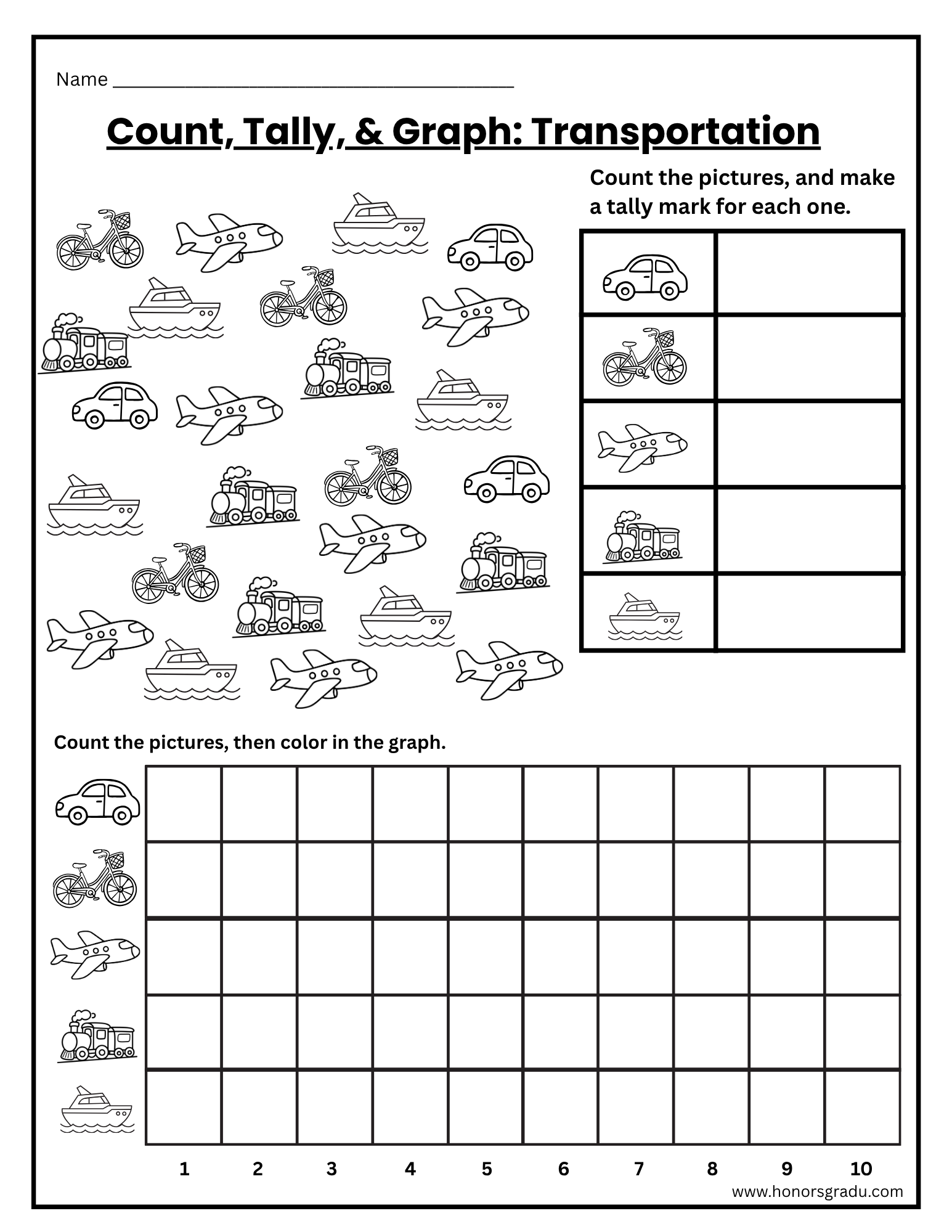
This week in preschool, my daughter learned how to count objects, tally them up, then make a graph. It is such a simple skill for my older kids (and for me), that it made me pause and realize that she’s just learning how to do those things. And you know what? That’s exciting! She’s learning new concepts and figuring out how to do things, and I love it!

So… if you teach preschool or even kindergarten, and you are working on graphing (or will be soon), I’ve got a fun worksheet you can use! Below is a download for a transportation themed Count, Tally, and Graph activity. Feel free to print it and use it in your classroom. 

** This download is for classroom or personal use only. Do not sell, repost, or claim as your own. **

CVC Easter Eggs

Last week, I shared some fun ways to use Easter eggs in your classroom. Today I have one more idea you can use! 

If you have students who are learning consonant-vowel-consonant (CVC) words, this activity would be perfect for your kiddos. Using the downloadable file below, students can practice reading and recognizing various CVC words.

There are two pages to the file: the first is the student worksheet, and the second is the teacher page. Teachers, cut out the word strips on the second page, and put each strip into an Easter egg. Give each student a set of eggs with the word strips in them. As they open each egg, they can read the word strip, then glue it on the worksheet under the corresponding picture. 

This download is for personal or classroom use only. Do not resell, repost, or claim as your own. 

Jelly Bean Math

Continuing with fun Easter themed activities for your classroom, today we’ll use jelly beans as a learning tool. The best part of using jelly beans is that your students can eat them when they are done with them! A fun, engaging learning activity and a treat?! Sounds like my kind of fun!

This activity would be best for first or second grade on up. Give each student a small bag of jelly beans. Using the download below, have them sort their beans by color, count how many of each color they have, then create a graph showing their results. 

Jelly bean math is a low-prep activity, which makes it very teacher friendly, and is fun, engaging, and educational, which makes it great for everyone involved! 

Download the worksheets below and try it out with your class! Happy sorting and graphing! 

**This download is free, and is for personal or classroom use only. Do not resell, repost, or claim as your own.**

Using Easter Eggs to Teach

Kids, especially younger ones, love hands-on activities. The movement feels like play time, and also helps build important neural pathways and connections. There are also benefits for increasing hand-eye coordination as students manipulate objects.

In the weeks leading up to Easter, I love to use plastic Easter eggs as manipulatives and learning tools. There are so many things you can do with them to make learning fun and engaging! The activities listed below are mostly geared toward preschool or kindergarten aged kiddos, but I’m sure older kids would enjoy them as well. 

  • Put rice or beans into eggs to make music shakers. Be sure to tape the eggs closed so you don’t end up with rice or beans all over your classroom!
  • Add eggs to a sensory bin for students to find.
  • Use eggs as a measuring tool– how many eggs tall is each student? How many eggs wide is their desk? How many eggs would it take to measure from one side of the classroom to the other? *For older kids, you could then have them measure the egg then calculate the actual distance.
  • Have students do a color sort with the eggs. Make it more challenging by hiding eggs around the room for them to find first.
  • Hide eggs around the room. Divide the students into small groups and assign each group a color. Whichever team finds all of their eggs first wins the game.
  • Make a chart with each upper case letter of the alphabet on it. Then, write each lower case letter of the alphabet on small pieces of paper. Put the papers in the eggs, hide the eggs, and have students find them. As they find each egg, they must match it to the correct upper case letter.
  • Inside each egg, put a piece of paper containing whatever it is they are working on learning– simple math equations, sight words, spelling words, trivia questions, etc. Hide the eggs around the room or in a sensory bin.
  • Put students in small teams. Give each team a container of egg halves. Set a timer and see which team can make the tallest tower from their egg halves in the time given. 
  • Students can use eggs to form letters or sight words.
  • Print off two sets of identical Easter egg pictures. Cut them out and have students play memory. You can also hide one set around the room and have them find each egg and find the match in the other set.  (see photo below)
  • Using the printed eggs, write a math equation, sight word, spelling word, etc. Students can pick an egg and complete the task on the egg.
  • Easter egg mix & match– Print the downloadable file below, then color each egg one color on top, and a second color on the bottom. Give students the cards and a container of egg halves. They can make eggs to match each card. (see photos below)

These activities would be so much fun for younger grades– give them a try with your students and let us know how they go! Parents of young children, these would be fun for you to try at home, too!

Play memory with matching eggs.
Print & color each egg card
Students can make eggs to match each card

Bringing Olympic Magic to Your Classroom

I don’t know about you, but I’ve been quite invested in the Winter Olympics since they started just over a week ago. There’s nothing quite like watching the world come together to cheer on top athletes as they live out their dreams. It’s inspiring and heartwarming. We’ve been able to sit down as a family and watch some of the events, and it has been so much fun!

I thought it might be fun to also bring the magic of the Olympics to the classroom. There are so many neat activities you can do with your students to bring the spirit of the games to the room:

  • Hold your own class Olympics– think minute-to-win-it type games or even make up your own “sports”
  • In small groups, have students construct ski jumps with cardboard, tin foil, paper, and whatever else you can find
  • Research the host country and learn about its customs, food, language, and geography
  • Make a large chart and keep track of the medal count together as a class
  • If you have a connection to someone who does a sport that is in the Olympics, invite them in to talk to your students about that sport
  • Have students draw themselves doing one of the sports
  • Graph medal counts as a math activity (see free printable below)
  • Survey the class on their favorite sports (see free printable below)
  • Pick one of the countries competing and learn some words from their native language

There are endless options to pick from to bring the Olympics to your classroom. Find what’s right for your class and have fun with it!

**The free downloads are for personal or classroom use only. Do not resell, repost, or claim as your own.** 

Math: Valentine’s Style

Number recognition and basic counting skills are fundamental math skills, and who says they can’t be fun to learn?! In fact, students are more likely to invest in and become engaged in learning these skills if they can connect a happy emotion to the experience.

I’ve put together a couple of fun, engaging Valentine’s Day themed early education math worksheets.

** These free downloads are for personal or classroom use only. Do not resell, repost, or claim as your own. If you’d like to share with others, please refer them to this blog post. **