How Vulnerability Lead To My Greatest Breakthrough

Graduating with a teaching degree in December can be a tricky thing. For me, I was in an area with too many teachers and not enough classrooms. While it may be an ideal situation for a school district, it was hard on me for finding work, so my solution was to sign up as a substitute teacher. Within the first few weeks, a principal from a nearby school called offering me a job as a long term sub for a first-grade classroom while their teacher was on maternity leave. I was overjoyed! The job wouldn’t start for a few months, but the teacher requested me to come in a few times to get a feel for the classroom and learn their daily schedule. 

I spent the next two months visiting the classroom about once a week, helping here and there, and getting to know the students. Right away, I could tell they all really loved their teacher, and even though they were excited for her to have her baby, they were sad to see her leave. 

I didn’t know it at the time, but immediately, I was intimidated. I felt like these kids already knew I was less of a teacher and that they would resent me for taking her place. Without even realizing, I started promoting myself to them, trying to prove that I would be a sufficient replacement. 

Every time I visited the classroom I promised them new things. “Guys, when I come to teach you we will do fun things!” My list grew and grew with promises. 

You love legos? Great! I’ll bring legos!

We can color ALL OF THE TIME. 

I have some super fun books that I can read to you guys! We can do read alouds all day long! 

Do you play the violin? We should find a day for you to play it for us! 

This was me showing them that I could be a fun teacher too. I was doubting my abilities, so obviously they had to be doubting them as well. 

It didn’t take long for me to realize that this would backfire. In fact, it only took one day. 

I walked in on my first day with the highest hopes and walked out at the end of the day in tears. Four kids had been shuttled to the principal’s office before lunch. During reading time we didn’t even make it through the text because there was too much side talking for anyone to concentrate. And walking through the hallways was a joke. I could not keep enough order to keep them in line, let alone quiet enough to not disrupt other classrooms. In fact, another teacher stepped into the hallway and yelled at the kids as we walked by because they were losing control. I was losing control. I knew I was failing. 

I had a 25-minute drive home to think about what went wrong and how I needed to fix it. As I pulled into my driveway, it all dawned on me. I never tried to be their teacher, I only tried to be their friend. And even though I truly believe in having a good relationship with your students and teaching to their needs, I also know that my prime role in the classroom is a teacher. 

Continuing on in my reflecting, I also came to realize that I actually didn’t have to prove myself to them. All of these inadequacies I was feeling came only from me, not from them. That night I sat down and made myself a plan for day two. Something needed to change in order for us to make it through the next 9 weeks together. 

Tuesday morning I started off different than their teacher ever had. I stood by the door, which immediately caught them off guard. I instructed each student as they entered to head to the rug for a meeting, to which most students gave me weird looks or protested because it was so out of the norm for them. 

Once we were all seated, I apologized to them for how the day had run previously. I apologized that I didn’t have better control of the class, that we were not able to learn much from the lack of management, and for the disruptions that hindered our day. I felt vulnerable in front of these first-graders apologizing for my mistakes, but it was a great learning moment for all of us. 

After apologizing to them, I laid out my expectations clear and simple for them. Talking while I am talking would not be tolerated. Walking through the hallways would look like quiet, respectful students who walked, not ran. Further expectations followed but ended with a powerful statement that I repeated to them for the remainder of my time there. I told them that they were the BEST class in the whole entire school and that they only sent me to be their teacher because of their exceptional behavior, and that I expected them to uphold this. 

Most of them did not believe me at first, they were known as a hard class throughout the school and they knew that. But I can promise you, I changed their minds by the time I left them. 

By the end of day two, I cannot say that we had a miraculous change. But I can say that there was an improvement. I took on the role of a teacher and it made a big difference. Little by little, we had better and better days. They were quietly walking through the hallways and raising their hands to speak more often. We still had our struggles and I still worked hard to maintain their confidence that they were the best class in the entire school, even when I was doubting it myself. 

I finally realized I had corrected my mistake a few weeks in as I walked my class to the library. They quietly filed in and followed the instructions of the librarian. Our school librarian looked at me in amazement and congratulated me. I asked what for and she said, “I have never seen this class behave so well, you are doing an incredible job with them! You must have been exactly what this class needed.” 

I had a little smile on my face as I walked back to the classroom. Little did she know, our first days together were chaotic and we hadn’t learned a thing, and it wasn’t necessarily the student’s fault, it was mine. 

I learned so many things from my long term sub job. One big takeaway that has helped me in my teaching is that classroom management is key and that relationships with students thrive after expectations are set. I couldn’t connect with them because I couldn’t gain control long enough to know them. 

I ended my 9 weeks of teaching with some of the greatest student relationships I have ever made. I may have taught them phonics and how to add two-digit numbers, but they taught me how to be the best teacher. And the most satisfying moment was when another teacher commented on how my class was one of the best in the whole school. I knew the potential was there all along, we just all needed to believe it a little more. 

What does your classroom management look like? How do you establish it with each new class? 

Cover Photo: deathtothestockphoto.com

Instead of Putting Fuzzies in a Jar, What If…

…we considered why we feel the need to drop a fuzzy into a jar to manage behavior (or to remove a previously-rewarded fuzzy), & then work from there?

…we held class meetings to discuss what our classroom needs to run smoothly and have follow-up conversations with individual students on how they might help?

…we enlisted student assistance in caring for the classroom environment with student jobs such as “wiggle monitor” (helps us know when the class needs time to get up and stretch) or “Calm monitor” (helps initiate a Calm.com session, which are free for schools)?

…we worked from a place of gratitude, continually naming every good thing we see in our classrooms? Not so we can manipulate, but so students know we genuinely value their efforts, talents, and consideration? See Amy Fast’s challenge:

No student should leave kindergarten (much less k-12 schooling) without a positive label: I’m good at _____. People like me because ______. I contribute meaningfully by ______. If students can’t finish these sentences, why are we surprised when they find unhealthy ways to matter?— Amy Fast, Ed.D. (@fastcrayon) July 13, 2018

…we worked to help students gain a sense of true ownership over the classroom and their learning experiences (see 10 ways for every student to be on their own learning path)? As Dave Meslin says for city planning (but applies to our classrooms, too):

Episode 2 of #LifeSizedCity. @meslin: “We take care of things we know belong to us. The trick is to get people to have a sense of collective ownership. Once they’re reminded that it’s theirs, they’ll make it better.” ❤️— Mary Wade (@mary_teaching) January 9, 2019

…we work to move away from collective punishments altogether, which can discourage individual students from doing their best (see Life After Clip Charts series)?

…we held an occasional class party just to celebrate all our hard work together (no strings; just positive, genuine celebrations of all the good that has happened)?

Just some questions from a teacher who has used far too many extrinsic “motivators” when I might have looked more to the messier work of building relationships. And still wondering…

featured image: DeathToTheStockPhoto

Owning That They CAN’T Always Control What We Think They Should

I used to think…students could control a lot more I do now.

Now I know…there is a whole lot more out of their control than I realized.

I used to think…part of my job as a teacher was to hold them accountable so they could learn responsibility.

Now I know…holding a child accountable for that which they have only partial or zero control is fundamentally unjust.

I used to think…self-control was all about helping them take care of themselves.

Now I know…sometimes our emphasis on control is less about their needs and more about our agenda. 

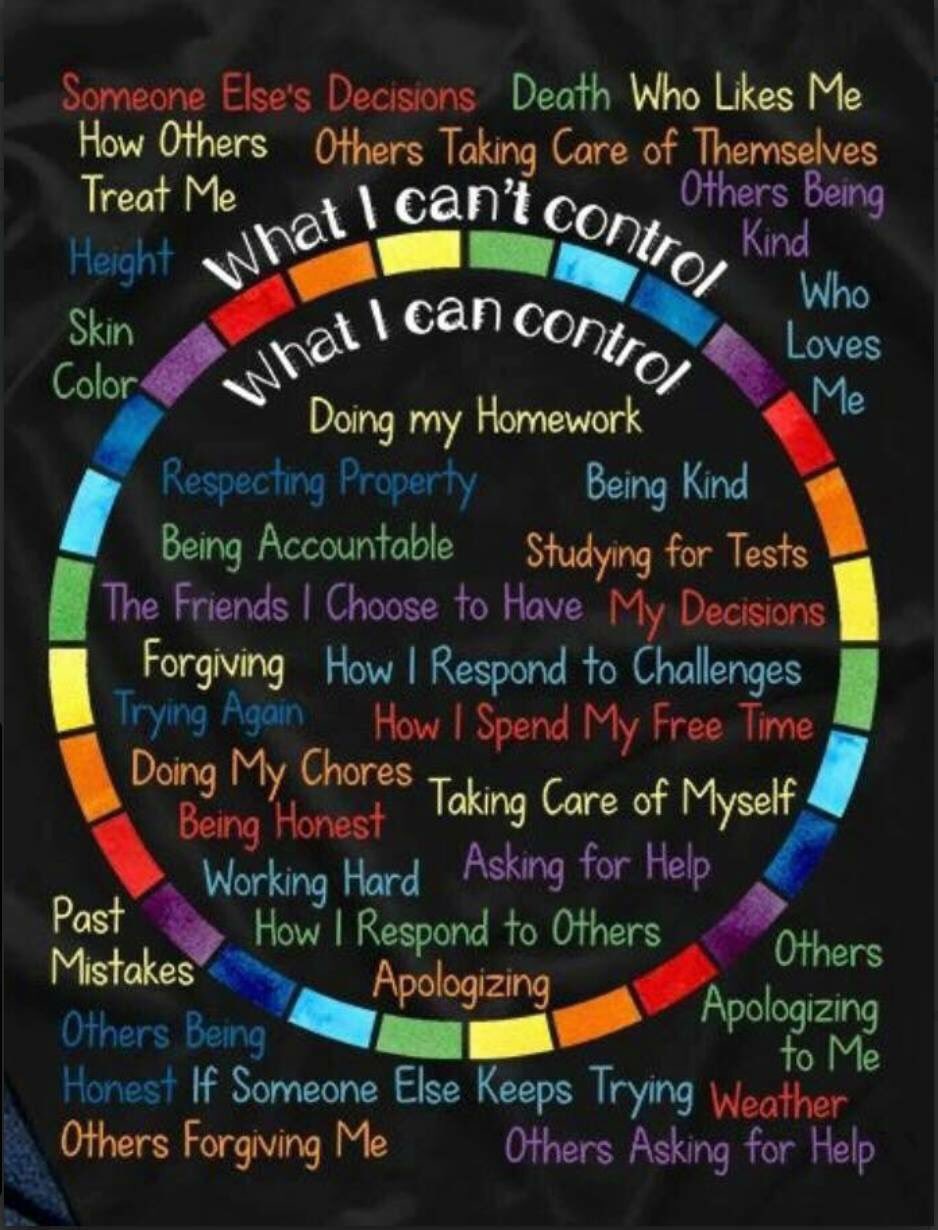
So as you view images like this “What I can/can’t control” example…

…consider these questions:

  • how might the home environment impact a student’s control homework completion (including but absolutely not limited to internet access, books in the home, library access, care for other siblings, etc.)
  • how might the way certain values are (or are NOT) emphasized and valued at home impact the way a student views them, such as education and hard work?
  • how might the stability (or lack thereof) of a students’ upbringing impact his/her ability to trust people enough to ask for help, try again, or respond to challenges in responsible ways?
  • to what degree should hold students accountable for values we have always been taught to cherish when they may have been taught that other values matter more (taking care of family over studying for a test, for example)?
  • how might chronic or toxic stress impact a student’s capacity for self-control?

I suspect the list of questions could go on for some time.

Which is why:

1) we can’t ignore the reality of compassion fatigue and why self care should be a massive emphasis for teachers everywhere. It’s incredibly draining for teachers who choose to seek understanding and responsiveness amid a myriad of difficult circumstances.

2) it’s worth considering why self-regulation > self-control.

3) I love Brene Brown’s Engaged Feedback Checklist, which I’ve shared on this blog many times. “I’m willing to put the problem in front of us rather than between us (or sliding it toward you).”

4) we should step away from the stickers:

“If a child is demonstrating stress behaviours, they may be telling us that our expectations are too much for them. Reducing the stressors may mean changing our program or our routines. If we are asking young children like Michael to sit for too long, listen for too long, or complete too many worksheets, then no number of stickers is going to be enough incentive for a child who is not developmentally ready.”

How can assuming more ownership over this issue of control with a stance of curiosity impact the students in your classroom?

featured image: DeathToTheStockPhoto

Creating Flexible Yet Significant Parent Volunteer Opportunities

Here’s the catch 22 of parent volunteers: you want them in your classroom, so you provide meaningful opportunities. They want to volunteer, but with other children, sicknesses, and other commitments, they don’t necessarily show up as planned. So teachers make their volunteer opportunities a bit less consequential — or even give up on providing opportunities altogether — so that no-shows won’t cause too much trouble.  And then when parents do come, they feel disappointed at the lackluster opportunity.

If this sounds familiar, you’ve come to the right place.

Here are some suggestions:

1) First, stick with meaningful opportunities. Keep those one-on-one reading slots, small group math work, and science stations. Focus instead on finding a system featuring built-in reminders for parents — with everything else going on, most teachers really don’t have time to send reminders, let alone coordinate cancellations! Keep reading to find an option that might work for you!

2) Rely on room parents. If you have a room parent, leave it up to him or her to coordinate opportunities with volunteers. This might include sending text reminders to parents who have signed up or helping to arrange subs.

3) Leverage Google appointments. Google appointments only work with school or business accounts, and they are wonderfully simple to use! You can add a single slot, or multiple slots with the duration you’ve set. You can also add a description so parents know exactly what they are signing up for! Then, simply give parents the link to your school’s “calendar appointment page” (which will be built in with your school account), and let them sign up. There are even instructions for cancellation. Full details here.

Bonus: use a URL shortener to get a short-link for your calendar appointment page and print it out on a handout to go home to reach parents that don’t check email. Do this throughout the year to remind them of opportunities you’ve added!

4) Use the Remind app. Send texts to all your students’ parents to let them know about volunteer opportunities, whatever your platform.

5) Pick a volunteer sign-up platform. I’ve seen SignUp.com and VolunteerSignUp.org. I’m especially impressed with the simplicity of VolunteerSignUp.org — it is very quick to add opportunities, and it automatically generates an email and a shortened URL to share with parents on social media or on flyers.

6) Work with your working parents. A post in Edutopia gave some great ideas here, including:

  • Scheduling reading circles and volunteer shifts at the start of the day so that parents can help before work
  • Using telecommunication platforms like Skype or Google Hangouts so that parents can read to the class or help with pre-scheduled assignments without being physically present in the classroom
  • Inviting parents to update the class website and social media
  • Preparing learning center materials from home
  • Helping in the school garden on the weekends

7) Solicit for special skills. Perhaps you have a graphics-savvy parent that might be willing to help with logos and posters. Maybe some even have connections with community members that might enhance your students’ unit of study.

8) Focus on cultivating genuine relationships with families. This goes beyond just sending an email when we need volunteers or when a child is struggling with behavior. As eloquently summarized by Larry Ferlazzo on ASCD:

“A school striving for family involvement often leads with its mouth—identifying projects, needs, and goals and then telling parents how they can contribute. A school striving for parent engagement, on the other hand, tends to lead with its ears—listening to what parents think, dream, and worry about. The goal of family engagement is not to serve clients but to gain partners.”

The above article describes possibilities like home visits and doing more listening than talking. I also wrote a few months ago about 10 ways we can partner with parents.

Above all else, we need to remember that we exist to support families, not the other way around. Volunteer work and all other aspects of the home-school relationship will be enhanced when we bear this in mind.

featured image: DeathToTheStockPhoto

Where Love & Logic Comes Into “Oppositional” Interactions with Students

In just a couple of weeks, I get to run a Love and Logic workshop at my old school. This has me reflecting on the purpose of the Love and Logic approach, and how it applies during particularly difficult situations.

For example, what do we do when our students actually seem to be getting something out of the opposition with us? One of Seth Godin’s recent posts examines what to do when someone refuses all our efforts to achieve a solution. “It might be, though, that being oppositional is making them happy. It may be that the best way to satisfy their objections is to let them keep objecting.”

Now, when that someone is very young and very stuck in their frustration or poor choice, we can’t very well just say “Fine! Keep being frustrated!” Not only does that kind of response leave everyone upset, but it doesn’t help teach the child better choices. So what options are left to us (especially when we’re not exactly feeling, “Oh, goodie, a learning opportunity!”)?

One of the important rules of Love and Logic is to keep anger, threats, and lecturing out of our communication, because kids actually tend to feed off this entertaining display of adult emotion.

So when a child is being oppositional, here are some Love & Logic strategies that might come into play:

  • Treat both the symptoms and causes.
  • Don’t set yourself up to lose, which includes avoiding making requests for a change in behavior in front of the class — the opportunity to argue on display can be another source that feeds the opposition.
  • Maintain your personal energy levels and feelings of dignity, even when logical consequences aren’t available, through the Energy Drain approach.
  •  Don’t feel like you must come up with a consequence in the very moment of the poor behavior, when emotions are likely running high all the way around. Instead, try Anticipatory Consequences.
  • Rather than engaging in arguments, neutralize them with statements of empathy or “one-liners.” Return to the discussion later when you are both calm and ready to talk.

We all want and need to focus on building the relationship with each child. But if they have become accustomed to argument and defiance, we must also work to help them break habits and understand that you value dignity, both for themselves and yourself. Through it all, work to be genuine and express love and appreciation for each and every child, because that is where any good relationship starts.

featured image: DeathToTheStockPhoto

Are Choices Only For the Well-Behaved? #TeacherMom

Readers here know I love a good quote. But in the swirl of the large volume of mental input/output, it’s rare one will stick around. This one from Greg McKeown definitely has taken up more longterm residence in my mind today:


Pernille Ripp also referred to it when writing about students’ reading choices. She makes an excellent case that all our students need choice in what they read — not just those who are already confident at making reading choices.

Which takes me to a closely related line of thinking when it comes to kids’ behavior. When our students misbehave, we tend to remove their choices. You’re going to be disruptive at the table during group work? You’ll be sitting by yourself now. You don’t do your work while sitting in the flexible seating area? Sorry, guess that means you need to be back at the desk. You abuse the privilege to use the bathroom when needed? Guess you’re using a limited pass from now on, my friend.

And this all makes sense, right? After all, logical consequences help our students understand cause and effect and to develop accountability for their actions. I’m certainly not one to dispute the importance of this kind of follow-through.

What I do dispute is the way these consequences tend to follow kids who struggle with school, day in and day out. Of course we need to work to minimize disruption, and sometimes that does in fact take more longterm action, such as behavior contracts to help students learn to recognize and correct their behavior.

But if we start to preempt kids’ behavior with curtailed choices, you can absolutely bet that helplessness is sure to follow. Particularly if they feel like they’re the only one who never gets a fresh start each day.

Contrast that path of helplessness with this message of hope — one that every child deserves to hear:

featured image: DeathToTheStockPhoto

4 Questions To Help You Inventory Your Classroom Wall Space

Every day of 4th grade, I stared at the gigantic poster stretching across the top of the whiteboard: “Common sense is not so common.”

I had not the slightest clue what it meant.

Other than a back-to-school lecture, my teacher never referred to it directly (or perhaps she did, but because of the above-mentioned non-comprehension, it probably just didn’t register).

I spent the year wondering about it to the point of distraction. I sensed that it was important to my teacher, so I spent time trying to crack its cryptic riddle. “Sense. Sense that is common. I think a sense is what you use to smell and taste and stuff. And common means a lot. So smelling and tasting that happens a lot? That doesn’t seem right. Especially since it’s also not common, somehow…

Today, I look back at this memory and chuckle at the sheer bafflement I experienced that year. But as a teacher myself now, reflecting on this does provide a bit more than just a laugh. It makes look inward to examine what kind of experience [intended or not] my walls have given my students.

In my first classroom, the teacher before me had left behind all sorts of posters on the walls, including posters on 6 traits of writing or motivational quotes.

But as the months moved on, I realized that they may as well have been wallpaper for all the benefit my students were getting from them. I did not integrate them in any meaningful way, and eventually, we decided we’d rather make room for student work.

Since then, I’ve found other messages and resources worthy to go on my walls that are the few exceptions to my student-created-only rule. But now I filter them with a mindset that wall-space is valuable real estate; tenants had better pull their weight. I’m not currently in the classroom, but plan to be back in a few years, so meanwhile, here are questions I ask myself as I bookmark, download, & log away ideas for future wall content:

  • Do I find this personally and genuinely inspiring? Some of you may be thinking, wait, aren’t we trying to inspire the kids, here? True. But I’ve found that displaying personally enlightening messages to be much more valuable than any cute monkey-face “you can do it” sign. Here’s why: If it causes me to elevate my practices, and if I regularly communicate to my students how and why it does so, it ultimately inspires students because I’m modeling to them ways I’m trying to become a better teacher for them.  I shared a few examples here, but Brene Brown print-outs are always my favorite:

Via www.BreneBrown.com

  • Is there a trace of lecture involved? If looking at a quote even faintly makes me wonder, “What’s the deal with kids these days!” (ie, the “common sense is not so common” poster) most likely, a) it’s not going to help my students as much as I think it will and, b) it runs too high a risk of damaging relationships with students.
  • Is it an intentional, interactive display designed to help students see themselves as authentic readers, writers, mathematicians, scientists, etc? This one is a little more abstract, but luckily, I found the perfect example last week on Nerdy Book Club. It’s bookmarked, tweeted, and had better stay in my memory for when I return to the classroom.

via NerdyBookClub by Jillian Heise

via NerdyBookClub by Jillian Heise

This particular display is meant to share progress on Donalyn Miller’s fabulous #BookADay (also see #ClassroomBookADay) challenge. To me, this isn’t just a bragging-rights kind of display–it’s also a beautiful and handy way to recall individual reads throughout the year that have been meaningful and instructive.

  • Does it bring some rapport-building humor to the mix? In the middle of a grammar unit? This kind of light-hearted and memorable fun would be a must-share.

Whatever you display, remember that there’s a reason that the physical classroom environment is called the “third teacher” — decide now what kind of teacher you want it to be!

What about you? What are your requirements for what goes on your classroom walls? Please share!

featured image: DeathToTheStockPhoto