My Favorite Positive Reinforcement Strategies In The Classroom

You can read countless research studies on a positive environment and how using these positive reinforcement strategies can help you see better behavior in kids, spouses, pets, co-workers and more. When it comes down to it, those who are properly praised for a task will statistically try harder and do better the next time it is expected of them. 

Creating a positive classroom culture starts with a simple positive comment toward your students. Here are a few of my favorite positive reinforcement ideas I came up with while teaching. 

A cheerio or other cereal placed on the desks of students who are following directions. 

Tally points on the board for groups that were working together or following directions, that ended up amounting to no reward other than “winning” against other groups. 

Little stickers for students showing correct behaviors. 

High-fives to those following directions. Oprah style worked best for us- “Johnny gets a high-five, Amelia gets a high-five, Andrew gets a high-five! Awesome job on following directions!” It’s amazing what kids will do for a simple high-five and a little public praise. 

Simple and subtle compliments to students working hard. 

We put a money economy system in place with coins. It’s fun to see the hard work first graders will put into cleaning up the floor at the end of the day when a plastic nickel is on the line. 

My favorite way by far was telling the class every single day what an amazing group of students they are. They become what you tell them they are- So tell them they are great and eventually they are going to believe you. I have more thoughts on this later, stayed tuned for another blog post regarding this. 

Praising positive behaviors yields productive results. It has been researched, it’s science. And on top of that, I’ve witnessed first-hand how well it works, not only with my students, but my children, and even, MY DOG. 

How have you made your classroom a positive place? 

What Substitute Teachers Wish Teachers Knew

Recently I wrote an open note to teachers from their subs. I’ve spent multiple school years substitute teaching in classrooms when full-time teaching wasn’t a possibility for me. After being in so many classrooms with vastly different situations each time, here are my best tips to teachers from their subs on how we can have a successful day with a few extra resources. 

  • Please don’t ever feel like you’re leaving too much information. We can be walking into a completely new school that day so assuming we know nothing is the best protocol. 
  • Giving us information on students is extremely helpful. Who might need extra help, who would be extra help, who to trust to run the classroom keys back down to the front office. Even certain behaviors to look out for and the best way to handle them. 
  • Knowing the attention-getters you use for your class can be a big tool for us. I can’t tell you how many times I’ve stood in front of a classroom singing out, “class, class” only to get weird stares from half the kids and louder talking from the other half. Leave us with at least one to use. 
  • Leave us with the name and directions to the classroom of one teacher close by that can help in a time of crisis. This can be something as small as turning on the projector, or as big as locking the classroom during a lockdown.   
  • We thrive on your lesson plans. I had a good friend tell me an awful story about a week-long sub job in a special ed classroom with no lesson plans. She had to come up with something to do every day that week with these students, in which she had no previous training on how to teach them, or what they are learning. In some states, a teaching degree or license is not required, so lesson plans are crucial. 
  • The classrooms I had the most success in had a binder with labeled maps, procedures, a class list, the lesson plans for the day. Everything we need to know right there, and something the teacher had to make once and only replace lesson plans as needed.  

We want to have a successful day teaching your students, and the more information we have to do this, the better! I have never walked into a classroom and thought the teacher left me with too much. Even if there was material that was never used it still helped me feel prepared.

Are you a substitute teacher? What other tips do you have? 
Are you a teacher? What tips do you have for subs? 

Taking Down The Baby-Proofing: Some Thoughts On Self-Reg

Like many households with toddlers and babies, we have outlet covers placed in every reachable outlet throughout the house. For the first two years of my daughter’s life, they stayed put and did their job, keeping her safe from electrocution. 

But alas, at some point, her curiosity and fine motor skills moved beyond the simple plastic and left us with outlet covers being pulled out left and right. 

At first, we tried telling her no. 

Then we tried redirecting her every time.

When neither worked, we attempted to show her how to put them BACK in the socket in hopes that once pulled out, she would put it back in. However, instead of putting the cover back in the socket, she started sticking anything else that might fit. I’m sure a lot of parents are familiar with the objects- Pencils, forks, fingers, straws, anything long and skinny. 

Finally, I was at a loss, what was I going to do to keep my daughter from getting electrocuted? This was becoming too dangerous. 

One night it dawned on me. She was two and a half at this point and I thought to myself, it’s time to stop trying to block her from the danger and start teaching her how to properly use them as a tool, making the danger lessen drastically. 

We had a quick conversation about outlets and power, at a two-year-old level of course, and what we use outlets for. I pulled out her tablet and charger and showed her how to properly plug in one side of the cord to the outlet and the other into the tablet. She practiced over and over taking it in and out of the outlet and watching the screen turn on when it would start charging. We also talked about what can and cannot be placed in outlets. Tablet chargers- good! Forks- No way. She was overjoyed with this new skill she had just obtained. 

At some point, we had to take away the baby-proofing and hand-holding to let our kids just experience the world for what it is. This can be true for crossing the road or walking to the neighbor’s house. Maybe taking off training wheels or taking off floaties in the pool as Mary talked about in a past post. 

How do we help students learn self-regulation in our schools that can be full of figurative outlet covers? What would happen if we let elementary students choose their own tables in a lunchroom instead of assigning each grade and class a specific spot? At first- chaos. But over time, think of the self-regulation this could promote in students with the proper scaffolding. Just like how I had to sit down and show my daughter step by step how to plug in her tablet and effectively use an outlet, the same would be done with the students. 

The benefit became apparent for me almost right away after removing every last outlet cover from our home. When the vacuum cord wouldn’t quite reach the far corner of the living room, my daughter came running to unplug it from the current outlet and move it to a closer one. Less work for me! When her tablet dies, she is responsible for plugging it back in. She is excited at any chance she has to use the outlets, and I don’t have to worry about forks and straws in them anymore! 

How do we find the balance of a well run, efficient school while also putting responsibility into the hands of students to behave and act in a respectful, responsible manner? And how do we get to the point where the two can become one? A well-run school that promotes student decision making and taking off the “outlet covers”? Tell me your thoughts.

Featured Image: pexels.com

My Best Field Trip Tips

Field trips season is coming this spring! Nothing causes kids more excitement and teachers more anxiety than a day outside of school in unfamiliar territory. Field trips can be so nerve-wracking because it takes planning, permission slips, parent volunteer sign-ups, and more. 

I spent two months in a 4th-grade classroom during my time student teaching, and during that time we as a 4th-grade team went on SIX different field trips! In my next block of student teaching, I was in a 2nd-grade classroom where we went on two field trips in two months. In my first long-term substitute teaching job after graduation, the first-grade team I was working with brought the kids on a field trip to the aquarium. All within the same school year, I was able to experience TEN field trips. 

Ten field trips in nine months with three different age groups gave me a lot of experience that I am here to share with you now! 

  • Prep the students beforehand- Don’t leave them with uncertainty, walk them through what will happen, how it will happen, and how you expect it to happen. Tell them how to enter the bus, how to sit on the bus, how to handle lunchtime, how to find you if they need you, and more. Set CLEAR expectations and repeat them again and again. 
Exploring and learning about The Great Salt Lake by getting into it!
  • Give your students examples and stories of why your expectations are set the way they are. The first field trip I went on with my 4th-grade class, their teacher told them a story of how she lost a student on a field trip because the student wasn’t following instructions and she wasn’t paying close enough attention. She made them a promise that she would pay extra attention to every single one of them and do her part if they did their part by adhering to expectations. Adding a personal experience helped those students realize just how important paying attention and following procedures really was. 
  • Count your students. Then Count again. And again. Always be counting the students.
  • Use the buddy system. It is used often and is somewhat obvious for teachers, and for good reason, it works! 
Writing in their field trip journals
  • Have your students keep a field trip journal to record their learning. Give them prompts during breaks to write about what they are seeing, learning, and doing.
  • Parents. You most likely have at least one parent in your classroom that is willing to step up and to help you with what you need. Utilize these parents as chaperones, organizers, and more! Use them as often as possible. 
  • Take pictures. If possible, take pictures of your students for parents to see and to show your students later as well. These memories are priceless and everyone will appreciate them later. 
  • HAVE FUN. There is no lie a certain level of stress accompanies any given field trip. But when it comes down to it, you’ve done the planning, you’ve prepped the kids, and now it’s time to enjoy the field trip and watch the students learn and grow in a new environment. 
Handcarts and pioneers are a deep part of Utah’s state history. Field trip at the American West Heritage Center in Wellsville, Utah.
Touring Utah State University’s campus

Field trips can be incredibly rewarding if they are done correctly. Students can learn and grow outside of the classroom and it can give them the hands-on experience they need to understand how the world works around them. Gone are the days of passive learning where we sit in desks and copy notes. Now is the time for active learning and putting understanding into the hands of the students. 

What are your best field trip tips that you would add to this list? 

Sincerely, Your Substitute Teacher

Dear Teachers, 

We see you. We see the work you put in. We see the sacrifice you make in providing your classroom with materials paid for out of your pocket. We see the extra janitorial work you do before, after, and even during class. We respect the amount of time you put into the learning of these students, spending hours before and after class writing lesson plans, making anchor charts, calling parents, and prepping for upcoming days. 

When we walk through your classroom we see smiles on your student’s faces. We see their excitement for learning and how hard you’ve worked to get them to this point. Your love and respect for your students are tangible by the way they talk so highly of you. We see how much you care about them too by the work you’ve put into each detail, their personalized name tags, the extra study chart you made when you realized they didn’t quite grasp concepts right away. We see it in the way you leave us notes about specific kids and their behaviors we need to be aware of- the students who are more difficult or the students who are big helpers. You know them, you know who they are and what they need. We see the sticky notes you leave for yourself about upcoming community events your students are in or the reminders for passing out those extra homework papers you’ve made at least 5 copies of this week since they all seem to mysteriously disappear in backpacks. 

We know you’re still an excellent teacher even though you had to take a sick day, or a personal day for conferences, vacation, or to visit family. We know you miss your students just as much as they miss you. We see what an accepting and inviting culture you’ve created in your classroom by the need your students feel to have you back.

We as substitute teachers are privileged to enter your classroom for sometimes as little as a few hours a day. We are given a tiny window of your space and we respect your noble work. So teachers, dear teachers, we see you. We respect you, and we are proud of you. Keep doing the great work you are doing, because you are the best teacher for this classroom. 

Sincerely, 

Your Substitute Teacher 

Why I Decided The Clip Chart Wasn’t For Me

Oh, the dreaded clip chart. You know the one I’m talking about. “So-and-so” is being great! Move your clip up! Oh, Jonny, that wasn’t appropriate! Move your clip down!” It’s no secret that teachers have become outraged by these classroom management resources. One quick google search will show you just how unpopular they are. 

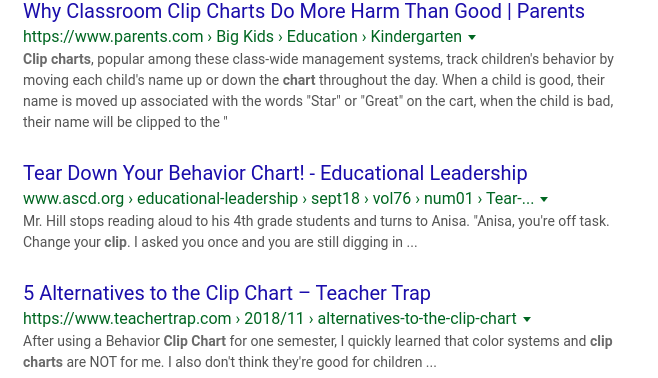
The first three articles to come up when googling “Clip Chart”

The first day I walked into the classroom of my long term sub job, I noticed one thing right away on the whiteboard- a clip chart. The public humiliation display. The does-more-harm-than-good tool. I did my best effort to keep the clip chart during my first week taking over the classroom, but I soon realized why it didn’t work. 

  • It was used for negative reinforcement more often than positive reinforcement. It was easier to use it for students misbehaving than to remember to reward those that were behaving. 
  • It didn’t change the behavior of the students who were constantly dropping into the negative. They quickly became numb to it, they didn’t care about moving their clip down, or up for that matter. 
  • I felt like our whole day revolved around the chart. Because I realized how often it was used for the misbehaving kids, I put in extra effort to use it to praise students for good behavior. It took too much time and effort. The best way to manage a classroom is to have an effortless, mindless, mostly positive plan in place. I needed a classroom management plan that was easy and natural for our classroom. 

So what did I do once I realized it wasn’t working? I stopped using it, slowly over time. I moved clips less and less, never making it a big deal or a spectacle that the clip chart was non-existent. I forgot about it and so did the kids. In fact, not a single student ever asked about it after we had fully stopped using it. Even the star students that were always at the top every day didn’t mind me phasing it out, no one wanted their behavior displayed to the entire classroom, including all of our visitors. 

Here’s what we did instead. We started our money unit, so a coin system was easily put in place. Each student had a container for their money and was solely responsible for it. Not very often was I taking pennies from the students, it was used more for positive reinforcement, which made everyone happier. It was incredible the drive the students had to clean up the floor at the end of the day when I would announce, “I have one nickel for every student who brings me ten pieces of trash!” I think we could have won awards for how clean our classroom was each afternoon. The money earned was used to pay for extra bathroom trips, new pencils, and a teacher store at the end of the year. 

We did a group point system on the board. I numbered each group, wrote the numbers on the board, and gave them points for being on time as a team, working together, and having their whole table quiet and ready to learn. It promoted teamwork and gave them an incentive to do better.

What did the point system on the board go towards? Here’s the magic of it- nothing. The points went towards nothing. Once the tallies made it to roughly 10 points per team, I would erase and start over. They were working hard simply for tallies on the board! I had one student ask quietly what the tallies were for. There were plenty of other side conversations happening at the time, so I chose to focus my attention elsewhere. I never heard any questions again after that one incident. 

Since I was teaching first-grade students, passing around a tiny sticker to hard workers was a huge motivation for them. I also kept a box of Cheerios in my cupboard to pass around one Cheerio to quiet, on-task students. After one or two times of doing this, they learned fast. As soon as the box was in my hand to pass them out, every student would be working hard. It amazed me how motivating one piece of cereal can be. 

Clip charts clearly are not a classroom management win. It may work for some and could possibly be excellent personal behavior management tucked away in a desk for one or two students that need it. But as a whole class approach, there are better options out there. Positive reinforcement has been proven to be the most effective for changing behavior, and clip charts do not promote this. Let’s all take a minute to put down the clip chart and pick up a more positive approach for our student’s sake. 

Be Firm and Be a Friend: How to Handle Those Difficult Students

I have stepped into many different classrooms with countless students over the years. Each room of kids seems to follow a similar pattern. The students that just want to help, they do everything they can to be the favorite. Then there are the students who sit in the back, keep to themselves, and try not to draw any extra attention. The ones listening intently to every word, but maybe not saying much. There’s always the students lost in their own thoughts of Minecraft or Fortnite, and the students fidgeting with things in their desks. There are so many different kinds of students you will run into in any given classroom, but there is always one student you will find no matter what. The kid that pushes your buttons and limits as far as he or she possibly can. 

I still remember the first encounter I had with one of these students, it was only a few years into my undergrad. I was in front of a fourth-grade class teaching a writing lesson, one of the very first full lessons I had ever taught. I was nervous as I stood in front of them, then took all of my excitement in me to exclaim, “Today we are going to do some fun writing!” 

A few students tuned me out, I knew it. Others paid a little more attention. One student, sitting on the front row smack in the middle as if he was purposely placed there to torment me yelled out, “WRITING SUCKS!” and had the whole class laughing within seconds. 

My little, tender, pre-teacher heart could not handle this. I choked back tears as I continued on with the lesson, ignoring his comment like I had been taught in my classroom management courses. “Class, who can tell me how many sentences make up a paragraph?”

“NONE BECAUSE WE DON’T WRITE ANYTHING FOR ANYONE.” 

His words crushed my soul. I made it through the lesson without crying, but their teacher could tell I was struggling because she pulled me aside at recess and asked if I was okay. I told her I struggled with this particular student and his comments. She sat me down and explained how he was testing my limits, what he was allowed to get away with around me. She told me the most important thing was that I needed to be firm, but also, be a friend. 

I took her advice and applied it the very next day. During the second part of my writing lesson, he thought it would be fun to hop onto his chair and dance for the class. I had to stand my ground and tell him that behavior was not appropriate in my classroom and that he would need to sit down. 

He didn’t listen right away, it took days and days of me repeating my expectations, removing him from the classroom, and calling on other teachers to assist. But slowly, we made improvements, he saw where I stood and started respecting that. Once we had somewhat mutual respect for each other, the friendship started. 

“Hey, Mrs. Ross, do you like football?” 

I can still remember him asking me that question in the hallway after school one day because it was the first interaction we had that wasn’t a power struggle between us. 

We proceeded to have a full discussion about football and he told me about his favorite college football team, BYU, and his favorite player, Taysom Hill. I asked questions and learned more about his passion for watching this game that I had never quite understood myself. 

He and I would chat often about recent games or the latest news with the team and even broaden our conversations beyond football at times. He would ask me about the latest news with my dog we were trying to convince our landlord to let us keep. At home, I would ask my husband the latest news on BYU and brush up on the current events with Taysom. Once we started building a friendship, the respect towards each other grew even further. 

This particular little boy was known throughout the school to be a tough student. Teachers in the hallways would try to reprimand him for bullying, running, and yelling to distract ongoing lessons, with no success. Eventually, I could give him one look, and he would know his behavior was not acceptable. Teachers throughout the school would ask me often what my secret was, how was I bribing him to behave? 

The truth was, no bribery was needed. This little boy needed one thing. Friendship. His teacher was in tune with him and knew which is why she advised me to do two things. Be firm, and be his friend. 

As I continued through my teaching career, I quickly found out that he wasn’t the only student like this that I would encounter.  I met many other students who attempted to push my limits and nearly bring me to tears, but at the end of my time with them, they always ended up being one of my favorite students because I spent extra time building a relationship with them. 

So next time you’re frustrated by that one student that always has a mean comment, or thinks it’s okay for her to crack inappropriate jokes during lessons, remember that it could be their cry for attention and love. 

Find out what they are interested in and truly care about it too. Ask them questions about the games they play and the friends they have. I’ve learned about college football, famous YouTube stars, Fortnite, JoJo Siwa, and more. They are all topics that have never been on my radar and most likely would not have if I hadn’t talked with them for a minute. Dude Perfect turned out to be more interesting than I ever would have expected!

At first, they’ll push you away and resist any relationship, it’s their defense mechanism because deep down they know they cannot continue to be the class clown if they start respecting you. But keep trying, be persistent, and just truly care about them and each of your students. 

I look back and think about these students often. I wonder how they are doing in school and genuinely hope that they have been passed along to other teachers that care about them as much as I do. I hope that they have someone to talk about BYU football and famous YouTube stars, because I know that’s the conversations they need to be having in order to learn about Shakespear and y=mx+b. I truly hope they are successful and that my short encounters with them made the smallest difference in their lives. In the end, that is the reason we are all teachers, right?