Thinking Outside the Box

One of my kids’ favorite books is called Not A Box by Antoinette Portis. A small rabbit demonstrates just how many things a simple box can be and proves that it can be anything your imagination allows. “It’s not a box!” has become a favorite saying at our house any time we have an empty box that one of our kids wants to create something with. Kids are so creative and have the best imaginations, and it’s fun to watch what they can come up with. 

You don’t have to have an empty box to get creative, though! Creativity can be sparked with next to nothing. Sometimes all it takes is setting out some paper, scissors, and glue. If you’re feeling adventurous, you might throw in an empty paper towel tube, some string, or even some pipe cleaners/chenille stems. I’ve even handed my kids a paper with just a few different lines on it, and they’ve turned those lines into a masterpiece. Simply put, you really don’t have to go crazy to give kids an opportunity to get creative. It really doesn’t take a lot. 

My kids have all had the same kindergarten teacher, and she has a “creation station” set up in her room. In it are bins of scrap paper, stickers, strings, etc. that are open for students to use. My kids have come home with the coolest creations that they’ve made. If you have space in your classroom, perhaps you might consider setting up your own version of a creation station. It doesn’t need to be fancy, but it would give students a place to create. If space is limited, or you have older students who might not be interested in gluing and taping paper together, consider providing some other kinds of creative outlets– coloring pages, color by number, origami, and so forth. You can also print off the circle and line art pages below and have them available for students to use. Or, if you’re a parent and need something to entertain your kiddos this summer, print off the pages and see what they come up with! You could even give it a try yourself!

Creativity is so important. Our brains were made to imagine, create, and problem solve. If we foster that natural need early on, and continue to do so, just imagine what kinds of amazing outcomes we will see! 

** These worksheets are for classroom or personal use only. Do not resell, re-post, or claim as your own. **

Read & Do: Practice With Following Instructions

One of the life skills that we teach and regularly practice with our students is the ability to follow either written or verbal instructions. Sometimes following instructions exactly is incredibly crucial– like when you’re doing an intricate chemistry experiment or assembling a bed, and other times– like when you’re making a peanut butter sandwich or coloring a picture, precision isn’t quite as necessary. Regardless of precision needed, learning to follow instructions is an important skill for all students to learn. 

To help your students practice this skill, I’ve created a set of four “Read and Do” worksheets. Three of the pages contain a picture and a set of instructions. Students read each instruction and complete the task. One page is a create your own “Read & Do” where students can write their own set of instructions, then trade with a classmate to have them follow the instructions. 

These worksheets give students a fun way to practice following specific instructions, simply for the objective of practicing following instructions. They provide a low-risk opportunity to practice this skill, as precision isn’t crucial. This activity is recommended for grades 1-3, but early readers could also benefit from its use. If you are wanting to have your students practice following verbal instructions, you can simply read them out loud to your class.

These worksheets are free to download, and are for personal or classroom use only. Do not resell, repost, or claim as your own.

Summer Learning

Learning doesn’t have to (and shouldn’t!) stop over the summer. It’s always a great idea to keep kids’ minds attentive and active. Doing so gives kids a chance to review the skills they already know, learn new skills, and to take a break from screens. It doesn’t take much, and it doesn’t need to take a long time, but a little practice a few times a week can go a long way. 

Summer learning doesn’t need to be fancy to be effective. Reading practice can be as simple as reading a story together then talking about it afterward. Science practice can be done by stepping outside at different times during the day to observe the different positions of shadows as the sun moves. Math practice can be as easy as taking a walk around the neighborhood and counting and tallying how many trees, birds, bikes, etc. you see while you walk. 

I’ve created two resources you can use for math practice. The first is an Independence Day Count, Tally, and Graph, and the second is a Neighborhood Count, Tally, & Graph. These worksheets are easy to print out and use. Take them on a car ride with you, do them at home, or even sit under a tree in your yard while you do them. 

However you choose to do it, make sure to find time this summer to provide learning opportunities for the kids in your life. Learning time is never wasted time!

*** These resources are free to download, but are for classroom or personal use only. They cannot be sold, reposted, or claimed as your own. ***

Summertime Math

For some kids, summer break is in full swing, and for other kids, it’s so close they can taste it! Trying to keep students engaged those last few days of school can be difficult, as they just want to be outside enjoying the sunshine. And, honestly, who can blame them?! The sunshine is so inviting! 

If your school is one that is still in session, and you find yourself grasping for ways to keep your kiddos engaged and focused, I’ve got a fun math worksheet you can use! Geared for kindergarten or first graders, this summer themed addition and subtraction practice sheet is fun and educational! And as an added bonus, if you need to occupy a little more time, you can have your students color in the objects as they work on the problems. 

If you’re a parent or caregiver who is desperate for ways to try to prevent the infamous “summer slide”, print this off and have your kiddos do it at home! 

However you use it, I hope your students and/or kids will have fun as they practice those fundamental math skills that will serve them as they continue to learn!

**This download is free, and is for classroom or personal use only. Do not resell it, re-post it, or claim it as your own.**

Say What?!

Happy as a clam. A picture is worth a thousand words. Every dog has its day. A penny saved is a penny earned. What in the world do these even mean?! Unless you are familiar with these kinds of phrases, they probably sound a bit silly, probably don’t make a whole lot of sense, and might even be confusing. Sayings like these can be idioms, like we talked about last week. Sometimes, though, they are known as proverbs: short sayings meant to convey some kind of moral or life lesson. 

As adults, we are likely pretty familiar with common proverbs and idioms. We hear them and say them without really thinking twice about it; we just know what they mean because we’ve known them for so long. For many of our students, however, these kinds of phrases are unfamiliar, and may sound like gibberish to them. 

Just like everything else, these must be learned. We can’t expect our students to understand them and know what they mean if we don’t expose them to proverbs and other phrases. To help you with this, I’ve created a simple worksheet you can use. On it, you will find a list of the beginning half of several proverbs or idioms, followed by a blank line. After reading the first half of the saying, students can write what they think the rest of the saying is. No doubt you’ll get some funny answers, but that’s the fun of it! 

** This printable is for personal or classroom use only. Do not resell, repost, or claim as your own. **

Having Fun With Idioms

The English language can be tricky. It’s a lot of “do this” and “don’t do that”, and a lot of words that are spelled the same, but have different meanings. Or, my favorite– words that sound the same, but are spelled differently and have different meanings, and that’s just how it is, because someone a long time ago made up the rules, so you have to memorize which word to use when. And then, on top of that, we have language devices that have their own rules and uses– metaphors, similes, hyperbole, oxymorons, personification, onomatopoeia, and idioms. It’s a lot to learn, a lot to remember, and can be a lot to teach. 

But… even though it can be a heavy load to learn and teach, the English language can be fun. Language devices, or figurative language, specifically can be fun. They help bring writing to life and can provide depth to writing. There are a plethora of engaging activities you can do with all grade levels to teach these concepts. 

Idioms can be especially fun. Kids often find the sayings funny, so it engages them. Below is a worksheet you can use with your students. It contains a list of idioms, with a place for students to write in what they think it means. The responses students give are always entertaining, and sometimes insightful.

** This download is free, and is for personal or classroom use only. Do not sell, post, or claim as your own. **

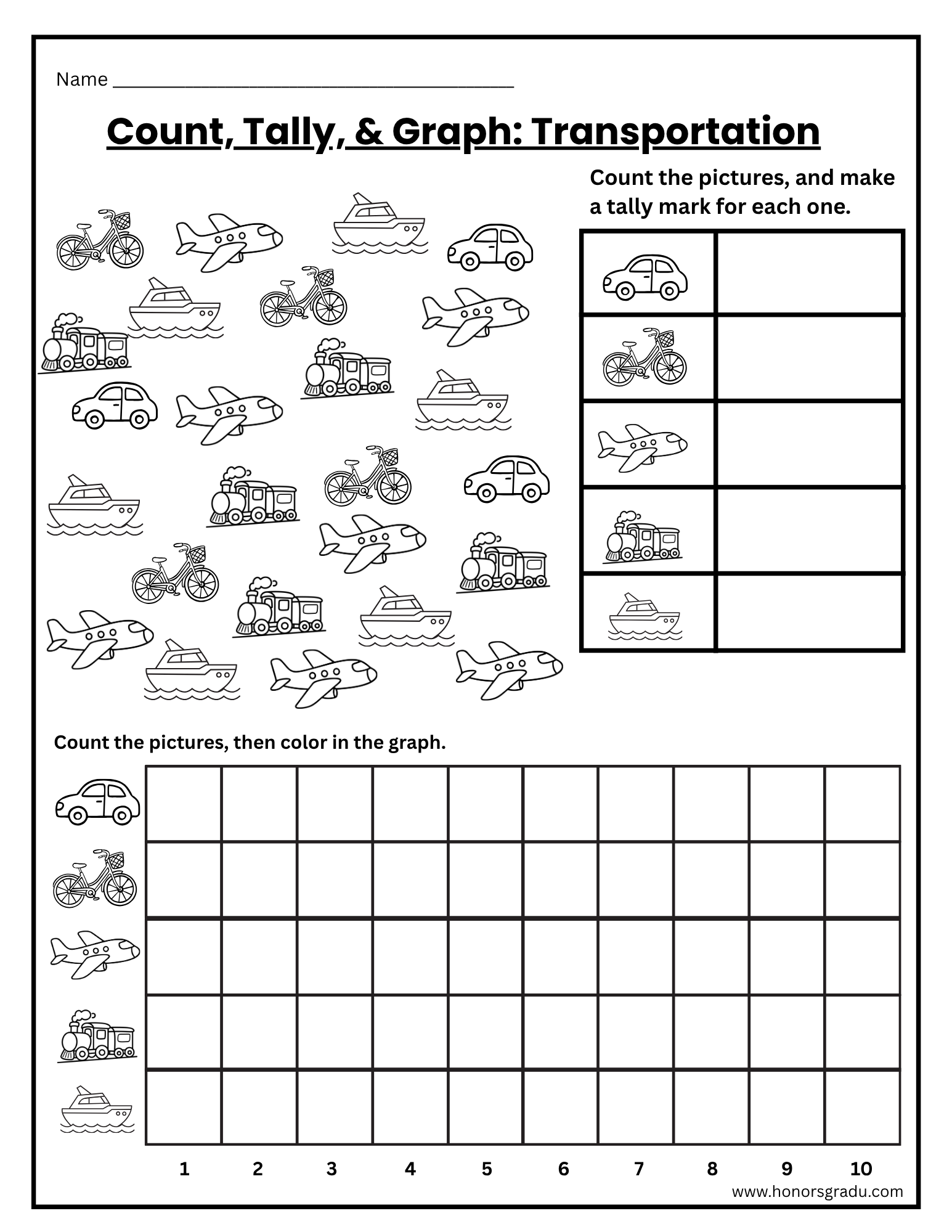
Count, Tally, & Graph

Much of what we teach our students is taught in layers, starting with foundational skills and knowledge, then we move onto the next level of difficulty, then the next, and so on. You can’t expect a preschooler to be able to do multi step equations when they are still learning to count, nor would you assume a third grader can tell you the differences between types of cells when they don’t even know what a cell is. It just wouldn’t make sense, and would lead to frustration on all sides. 

Skill building is especially important when dealing with math. Sometimes as adults, we don’t realize how much we already do know, because working through the processes and methods we’ve learned is almost automatic for our brains. We know what addition is. We know what it means to make a tally mark. We understand what a graph is and how to make one. 

This week in preschool, my daughter learned how to count objects, tally them up, then make a graph. It is such a simple skill for my older kids (and for me), that it made me pause and realize that she’s just learning how to do those things. And you know what? That’s exciting! She’s learning new concepts and figuring out how to do things, and I love it!

So… if you teach preschool or even kindergarten, and you are working on graphing (or will be soon), I’ve got a fun worksheet you can use! Below is a download for a transportation themed Count, Tally, and Graph activity. Feel free to print it and use it in your classroom. 

** This download is for classroom or personal use only. Do not sell, repost, or claim as your own. **