10 Back-to-School Icebreaker Games

Icebreakers aren’t just fun–they can play an essential role in helping your students become comfortable with each other at the beginning of and throughout the school year. They also have serious potential for team-building, bonding, and concentration!  This is a tried-and-true list of beloved games, especially suitable for upper elementary and older grades.

7/28/15: As you make plans on how to use this list, check out my follow-up post: Icebreakers: A Learning Moment & Follow-Up


Game of Whiz:

Description: This icebreaker is sure to help everyone get comfortable with each other and have fun as they play with sound effects.

[bg_faq_start]

Instructions:
  • Everyone stands in a circle facing each other.
  • Pick a person for the first turn.  He or she can pass the turn by doing one of the following actions/sounds:
  • Saying, “Whiz,” while turning with hands extended as if passing an object to the person on the right or left only.
  • Saying, “Sha-na-na-na-na-na-na,” while waving arms like tentacles across the circle to someone else (make eye contact so they know who you are passing the turn to!)  Note: The person across the circle has to receive the turn by saying “Sha-na-na-na-na-na-na” back at the passer before passing the turn to someone else!
  • Yelling, “Ahhhh!” while putting palms together and pointing at a new person. Note: The person across the circle has to receive the turn by yelling “Ahhh” back at the passer while putting their palms together above their head before passing the turn to someone else.
  • If someone tries to pass “Whiz” to you, you can also deflect it by putting your palms out and saying, “Boink!” Then that person has to pass the turn the other direction (“Boink” only allowed with “Whiz.”)
Winning:
  • After a couple of practice rounds, you can try elimination, where people get out if they forget to receive the “Sha-na-na’s” or yells properly, or otherwise mess up.
  • The last two people standing win!

[bg_faq_end]

Hoi Game:

Description: Another great icebreaker that allows everyone to just be silly and have fun together as they train with their “samurai sword” hands, drilling, “Hoi!” at each other.

[bg_faq_start]

Instructions:
  • Everyone stands in a circle facing each other.
  • Everyone puts their hands together as if in samurai training and bows to each other chanting, “Hoi, hoi, hoi, hoi, hoi.”
  • Then the first person puts their palms together with arms extended, and while pointing them at someone says, “Hoi!”
  • The person who was pointed at has to respond by putting his/her hands above his/her head with palms together while saying, “Hoi!”
  • The two people standing on either side of the person pointed at also put their palms together and slash at that person’s torso (without actual contact), saying, “Hoi!”
  • After their neighbors slash and say hoi, the person with their hands above the head then drops them in front, pointing at a new person, and saying, “Hoi!”
Winning:
  • After a couple of practice rounds, you can try elimination, where people are out if they say “hoi” out of turn, lose the beat, or motion their hands in the wrong way.
  • When you get to the last two people, the leader can have them stand back to back, walk 5 paces, and then turn and “hoi” at each other–the first to say it & point wins!

[bg_faq_end]

Assassin

Description: This game takes serious observations skills as everyone pretends to be diplomats at an international conference, mingling among an assassin!

[bg_faq_start]

Instructions:
  • Everyone stands in a circle facing out (no peeking!)
  • The leader is in the center and walks among them, talking about random topics to serve as a distraction as to who they choose as the assassin. The leader taps one person on the shoulder twice, designating him or her as the assassin, and continues to walk and talk a bit to keep anyone from knowing the assassin’s identity.
  • The leader tells everyone to turn and then mingle as if they’re at an international conference.  They should shake hands while saying hello in another language (Variations: leader can tell everyone to greet each other as an animal, or in an accent, etc.).
  • The assassin mingles, too, and intermittently kills people as they shake hands by squeezing someone’s hand twice.
  • Once their hand has been squeezed twice, a person should fall to the ground and faint or die as dramatically as possible.
Winning:
  • As people begin to notice a pattern, someone can raise their hand and shout, “I have an accusation to make!” Someone else has to say, “I second the accusation” for the person to make the accusation–if no one seconds it, they die.  If someone seconds it, the leader counts to three, and then the two people have to point at the accused assassin.  They must point at the same person! If they disagree, they both die.
  • If they both point at the same person, and that person is the assassin, they win. If they both point at the same person, and it’s not the assassin, they both die.

[bg_faq_end]

Carriwitchet

Description: This is a variation of the popular game, “Fruit basket.” Only instead of calling out fruits, the person in the middle calls out get-to-know-you descriptions!

[bg_faq_start]

Instructions:
  • Everyone stands in a circle facing in on a place marker (or sitting on their chairs).
  • The person who starts out as “it” stands in the middle without a place marker, and calls out “Carriwitchet if you have        [person shares something about themselves or something they’ve done]!”
  • Everyone who has also done that thing or who shares the description has to find a new place marker. When switching, you must find a place at least 2 place markers away.
  • The person in the middle runs to a place marker, and the last person without a place marker is the new “it” in the middle.

[bg_faq_end]

Concentration

Description: This is a great clap/chant game to help get everyone in rhythm and unified! It’s also fun to see how many words for each topic the group can come up with.  It is a trickier game to get used to, though, so make sure you have plenty of time for everyone to practice the beat!

[bg_faq_start]

Instructions:
  • Everyone sits in a circle facing in.
  • The leader starts everyone off in the clap/snap/chant pattern as follows:
Opening Verse spoken by all: Subject-choosing verse spoken by leader while everyone continues the hand rhythm
  • “CON- (pat legs)
  • -CEN- (clap hands)
  • -TRA- (snap with one hand)
  • -TION, (snap with the other hand)
  • Concen- (pat)
  • -tration (clap)
  • Is the (snap)
  • game. (snap)
  • Keep (pat)
  • the (clap)
  • rhy- (snap)
  • -thm, (snap)
  • keep the (pat)
  • rhythm (clap)
  • to the (snap)
  • end.” (snap)
  • (pat legs)
  • (clap hands)
  • “Subject (snap with one hand)
  • is (snap with the other hand)
  • (pat)
  • (clap)
  • [states subject] (snap)
  • (snap)
  • (pat)
  • (clap)
  • Starting (snap)
  • with  (snap)
  • (pat)
  • (clap)
  • [states example] (snap)
  • (snap)
  • Ideas for subjects:
  • fruits, desserts, cereals, sports, school, summer, animals
  • When you state your example, it must be on the snaps! If it’s more than one syllable, you can say it over both snaps, but it cannot be spoken with the pat/clap.
  • Everyone goes counterclockwise around the circle from the leader stating an example of the subject when it is their turn.
  • NO repeated examples!
Winning:
  • After a few practice rounds, you can try elimination. If a person can’t think of something on their turn, says their example off-rhythm, or repeats an example someone else already said, they are out!

[bg_faq_end]

Big Booty

Description: This is a classic concentration rhythm game, where everyone tries to get the Big Booty out!

[bg_faq_start]

Instructions:
  • Everyone sits in a circle facing in.
  • The leader is “Big Booty,” and then everyone else numbers off counterclockwise, starting at 1.
  • Everyone puts their hands in the air and says, the following:
    • “Ahhh, Big–”
    • BOO-ty, (pat). They start a simple pat/clap pattern.
    • Big BOOty, (clap on “boo”)
    • Big BOOty. (pat on “boo”)
    • (clap)
    • Big Booty, (pat)
    • Number __ (clap)
    • (pat)
    • (clap)
  • Big Booty starts off by passing his/her turn by saying their own title, and then someone else’s number.
  • One pat/clap beat in between turns.
  • The person whose number is spoken then receives the turn by saying their number and then passes it by saying someone else’s number, or “Big Booty.”
Winning:
  • After a few practice rounds, you can try elimination.  If someone doesn’t receive their turn by saying their own number first, missing the beat, or responding when it’s not their turn, they are out.
  • When someone gets out, they go the end of the numbers (to the right of Big Booty), and everyone numbers off, starting at 1, to the left of Big Booty.
  • The goal is to get Big Booty out  and to become Big Booty yourself!

[bg_faq_end]

Captain’s Coming (source)

Description: This is a silly version of Simon Says that gets everyone scrambling to follow the captain’s orders!

[bg_faq_start]

Instructions:
  • The leader is the captain, and is in charge of calling out actions and refereeing
  • Actions to be called out:
    • “Captain’s Coming!” (1-person command): Everyone stands at attention with their hand in salute, and they can’t move until the captain says, “At Ease!”  If the captain calls other actions before saying, “at ease,” and people move to do them, they are out!
    • “Man Overboard!” (2-person command): One person drops to one knee the other stands behind them, puts a hand on their shoulder. Both put their hands above their eyes to look for the man overboard.
    • “Crow’s Nest!” (3-person command): Three players stand with their backs toward each other and link elbows, forming a crow’s nest.
    • “Mess Table!” (4-person command): Four players huddle around a make-believe table and pretend to eat savagely, making sounds like, “NOM-NOM-NOM-NOM!!”
    • “Walk the Plank!” (5-person command): Five people stand in a single file row hands on the shoulders of person in front of them.  The captain comes and counts out five, starting with the person at the front, but people can keep trying to shuffle into the front of a line of 5 to get included in the plank until the captain starts counting.
    • “Mermaid!” (optional 1-person command to get everyone cracking up): Players each thrust out the right hips, puts the right hand on that hip, and makes an exaggerated tail wave with the left hand, yelling, “Howdy, sailor!”
  • The captain should revisit “captain’s coming” from time to time to see if everyone is paying attention with “at ease.”
Winning:
  • Everyone has to get in groups, doing the correct actions within a few seconds, or the captain declares them out!

[bg_faq_end]

Crabwalk Shoe-Tag

Description: This is a great rainy-day indoor game that gets everyone moving and having fun.

[bg_faq_start]

Instructions:
  • The leader sets up a rectangular perimeter with markers.
  • Everyone loosens their shoelaces or shoe straps and then gets into a crabwalk position on all fours.
  • When the leader says, “Go,” everyone crabwalks around trying to knock off each other’s shoes.
Winning:
  • Last one wearing a shoe wins. 🙂

[bg_faq_end]

Two Truths & a Lie

Description: This game is a great way to learn about each other–not only the things that people have done, but how good they are at being sneaky. 🙂

[bg_faq_start]

Instructions:
  • Everyone thinks of two true things they have done and one thing they have NOT done. (for younger students, you might even have them write down their ideas.  You may also want to teach them about what makes it fun; saying, “I have 1 brother, I have 2 brothers, I have 2 uncles,” isn’t a particularly interesting one for anyone to guess, which is partly why we emphasize telling them to share things they’ve done).
  • Other players take a few turns guessing which is the lie, before the person reveals it!
Winning:
  • The person who correctly guesses the lie gets the next turn!

[bg_faq_end]

Never Have I Ever

Description: This is another classic get-to-know-you game that my students always enjoyed playing in the hallways while waiting for the next activity!

[bg_faq_start]

Instructions:
  • Everyone puts 5 fingers in the air.
  • The  person whose turn it is says, “Never have I ever ___(something they have honestly never done that they think other people have done)___.”
  • Anyone who HAS done it must put down one finger.
Winning:
  • The person who still has at least one finger up wins!

[bg_faq_end]

Photo Source

Antoinette van de Rieth (featured image)

How to Set up Democratic Classroom Jobs

When you set up your classroom, is democracy a mindful priority?

Background

I’ve never forgotten the story of how one of my favorite college professors was begged out of retirement to teach 2nd grade–the evening before school started. When she walked into her classroom on the first day of school, it was to bare walls, stacked desks, and puzzled students.

They sat down on the floor together. Eventually, a 7 year-old timidly shared that things felt a little off, to which the others agreed.  When my professor asked them what a classroom should consist of, one girl raised her hand and said, “Well, last year, we had chairs.” They set to work arranging the furniture, and then regrouped. Then, another boy offered, “We also normally have pencils.” Together, they procured a supply.  And so it went for the first part of the school year.

I’ve always remembered the ending to her story: that those students owned that classroom as none of her students had before or since. And with a wink, she added that she didn’t necessarily recommend having zero preparation before the school year started–at least for the sake of school administrators’ sanity.

The Set Up

The idea of incorporating classroom jobs centers around ownership. This is more than about classroom management or clean-up–it’s about empowering students with the understanding that the feel of their learning environment is in their hands.

Hold a class meeting early in the school year to discuss the shared nature of your classroom’s physical, emotional, and academic space.  Brainstorm tasks you all feel are necessary for smooth maintenance, safety, and support.  You may opt to show students your list from the previous year, and then allow them to help you modify it based on their unique needs.  Or you may choose to go the way of my professor, and allow your students to start from scratch!

Pass out a job application so students can list their top choices and reasons they believe they would qualify for the job.

Additional options to consider:
  • Interview each student before assigning jobs.  I’ve had groups that enjoyed dressing up for a more formal and “official” experience.
  • Set aside “job time” at the end or beginning of the day for those students whose jobs require some time; you may choose to have the other students read, journal, etc., during that time.

List of Job Ideas

Whatever your approach, below are jobs that have all been tried by my fifth graders (with the exception of a “social media manager,” which I plan on trying out as soon as I resume teaching)!  The number to the side is how many students I’ve typically had doing the job, but be sure to base things on your class needs and size!  Also note that some are combos based on how much time some jobs took. Feel free to share these with your students to help them get inspired!

Paper Passers/Absentee Buddies:
  • Description: Passes out any appropriate papers daily and picks up papers from groups. During job time, they get materials gathered for any students that are absent, write down assignments for the day, and leaves them neatly on their desks.  (2)
  • Qualities:  FAST, excellent attendance, organized, hand-writing
Folder Filer
  • Description: Files all graded papers and handouts into each student’s file of papers that are to go home. (2)
  • Qualities: Memory skills, FAST
Lunch/Classroom Maintenance
  • Description: Carries lunch basket daily. Also gets the room ready for projector use when needed by quickly pulling down the projector screen, turning off the lights, closing the blinds, and turning on the projector. During job time, they check all the walls for repairs & remind tables to clean up desks/floors. Takes care of all other classroom maintenance as called upon.  (2)
  • Qualities:  Strong, lines up quickly at beginning of line, tall, takes initiative
Homework Checker
  • Description: Checks all planners at the end of the day during job time.  They also check for completion of the homework journal/project each Friday morning, and reports and missing work to the teacher in the morning.
  • Qualities: Responsible, thorough, organized. (1)
Birthday Coordinator
  • Description: Makes birthday cards for each student on their birthday/half birthday, and then get signatures from everyone in the class.
  • Qualities:  Good handwriting, artistic, thoughtful, AMAZING memory! (1)
Question of the Week Keeper
  • Description: Comes up with brainteaser questions and answers for the Question of the Week and lets the payroll know who gets bonuses for getting it right. (1)
  • Qualities:  Good handwriting, likes puzzles, organized. (1)
Event Manager
  • Description: Updates the daily schedule and keeps the monthly calendar correct.
  • Qualities:  Tall, memory skills, VERY neat handwriting (1)
Assistant Event Manager
  • Description: Assists the event manager with anything he/she needs help with.
  • Qualities: Neat handwriting, tall, organized, memory skills
Board Eraser
  • Description: This person will need to erase the board after each recess and whenever else it is needed. Thoroughly cleans the board during job time. (1)
  • Qualities:  Tall, strong, pays attention, neat
Payroll
  • Description:  Reminds all students to add their paychecks to their check registers every payday.  They also check with students who have bonuses each day during job time to make sure they’ve recorded in their check registers.  (1)
  • Qualities:  listener, math money skills, honest
Debt Collector
  • Description: During job time each day, they check with any students who have fines to make sure they’ve recorded them in their check registers. (1)
  • Qualities:  organized, listener, math money skills
Cashier/Pledge Leader
  • Description: Handles money during the class store by helping students write checks and subtract from their check registers. Assigns prices to class store items. Also stands and leads the pledge every morning. (1)
  • Qualities: honest, math money skills, organized, memory skills
Behavior Recorder/Assistant Room Manager
  • Description: Writes down daily fines and bonuses and then records them on the board during job time. Also assists the room manager with filling in for absent students. (1)
  • Qualities: responsible, great memory, honest
Room Manager
  • Description: Makes sure that everyone is doing their job daily. Also fills in for any job if a student is absent. (Must know responsibilities of all jobs) Takes care of all other leadership/management tasks as called upon. (1)
  • Qualities:  Organized, attentive, fast Learner, leadership
Line Leader
  • Description: Leads the line daily. Learns assigned places to stop & keeps the class straight and quiet by giving firm reminders to students that need to stop talking or walk single file. (1)
  • Qualities:  listener, respectful
Line Ender
  • Description: Ends the line daily to all destinations and turns off the light as class leaves. If any student has to return to the classroom to retrieve a forgotten item, the line ender is required to go with them. Keeps the class straight and quiet by giving firm reminders to students that need to stop talking or walk single file.
  • Qualities:  Fast, good listener great memory, respectful
Class Journal Keeper
  • Description: Updates the class journal each day during job time with a description/illustration of the day’s events. (1)
  • Qualities: Artistic, neat handwriting
Class Photographer
  • Description: This person must have access to a digital camera that he/she can bring to school on a regular basis.  They are in charge to taking pictures of exciting experiments, debates, parties, and anything else; they then need to email pictures from home to me occasionally.  (1)
  • Qualities:  Takes initiative, very responsible, photography/technology skills
Messenger
  • Description: Runs any notes or errands throughout building throughout the day.  Collects Mrs. Wade’s mailbox items from the front office every job time.  (1)
  • Qualities:  Knows school and different teachers, communicator, fast walker, polite, honest
Lunch Counter
  • Description: Also, each morning makes sure all students have moved lunch magnets and then counts/writes down how many for each option. Moves the magnets back at the end of the day.  (1)
  • Qualities: organized, memory skills, fast
Sanitation Specialist
  • Description: Using disinfectant wipes, cleans all desks, tables, (and if time), chairs at the end of each day during job time. Cleans other surfaces as needed. (2)
  • Qualities: Attention to detail, helpful, respectful to others’ belongings
Organization Expert
  • Description: Helps keep the entire class organized; organizes the guided reading desk/teacher area as needed, helps other students with organizing their desks, organizes other things around the class when it gets cluttered. (1)
  • Qualities: Um, organized.  🙂 Also, takes initiative, meaning they don’t need to be asked to notice & jump in to help.
Class Medic/End of Day Caller
  • Description: Keeps band-aids in their desk and distributes to students. Also makes sure everyone takes home their lunch boxes/coats/backpacks.(1)
  • Qualities:  Fast, memory skills, reliable
Clubhouse keeper
  • Description: Straightens up the clubhouse and sorts the books during job time every day. Checks for any damages to books and fixes them or reports them to the teacher as needed. Maintains all other clubhouse materials to keep things looking nice. (1)
  • Qualities:  Organized, respectful to books
Scribe/Word Wall Attendant
  • Description:  On Monday Meetings, this person will write down all the items of business discussed and report at the end. This person also maintains the word wall chart during job time by neatly writing great words we encounter as a class. This person will also take notes whenever we go over important things, remind the teacher of things, and advance PowerPoint presentations during lessons. (1)
  • Qualities:  handwriting, organized, memory skills, strong computer skills
Supplies Station Manager
  • Description:  Sharpens pencils at the end of the day and keeps track of/replenishes all supplies that are running low.  Also cleans up/disinfects the entire supplies station area daily. (1)
  • Qualities:  Great memory, dedicated, attentive to detail, organization skills
Social Media Manager

For a printable version of my list, click here! And if you have additional jobs that your students have loved, please share in the comments!
Photo Credit (featured image): maaco

5 Small Habits that Will Transform Your Classroom

Flipped classrooms.  Project-based learning.  BYOD. Homework & standardized testing overhauls.  These are some of the big-picture aspects that help define the 21st century education landscape. But when we approach it with only these kinds of large-scale changes in mind, the shift will be daunting and slow. Here are five minor 21st century habits to try out for major potential for change!

Continue reading “5 Small Habits that Will Transform Your Classroom”

5 Business-Inspired Tips for Progressive Classroom Management

You’ve probably noticed that approaches to education and business tend to clash.  After all, we spend about 13 years training students to memorize and then produce results in bubble sheets (which tends to untrain them from their natural tenacity, creativity, and passion), and then we suddenly hope they’ll be innovative and creative leaders once they join our workforce.  One way to help beat this paradox: find applications for improved educational practices among the advice columns in the business world.  Below are just a few examples.

Continue reading “5 Business-Inspired Tips for Progressive Classroom Management”

How to Teach Empathy–& Why it Matters

It’s easy to get caught up in the frenzy of efficiency as teachers.  Standards and tests and data and reports bear down on us with pressure to make every. minute. count.


Efficiency Enterprises

There also seems to be an endless supply of initiatives to maximize our efficiency–many of which seem to simply offer more fodder for burnout, like some ideas found in the video below (at the proposition for increased class sizes for quality teachers, I could only visualize the exhausted expression of one of my mentor teachers the year they increased her first grade class size–because she could handle it, right?).

2/3/15 UPDATE: It appears that OpportunityCulture.org has removed their video after we published this post a couple of weeks ago. So, to fill you in if you missed it, the ideas we found most worrisome in the video included: 1) increasing class sizes for “excellent teachers” so more students could feel their influence (while decreasing class sizes for novice teachers); 2) implementing rotating classes for those “excellent teachers” so they could reach even more students each day; 3) an apparent oversight of the teacher-student relationship in general. Instead, their page now says the following: 

“Watch this space for an updated motiongraphic, based on the experiences of the first pilot schools to implement their own Opportunity Cultures, showing the importance of models that let teams led by excellent teachers reach many more students, and let all teachers earn more and learn more—through more school-day time for collaboration and planning, and without forcing class-size increases.”

10/29/2015 UPDATE: A new video has been published. The model is explained differently, but the basis still rests on class-size increases for excellent teachers and efficiency, which still leaves us concerned about the lack of discussion on teacher-student relationships. 

 Kim Collazo’s response on Twitter brings to light what’s most worrisome about these kinds of ideas:

Empathy Over Efficiency

Efficiency values time-management; empathy values taking all the time that is necessary to build relationships. Both have their place in our classrooms, but we must be careful that the more aggressive pursuits for efficiency don’t swallow up the daily opportunities to foster our relationships.  To learn more about why empathy is so important in every relationship, see the poignant RSA video below in which Dr. Brené Brown describes how to discern genuine empathy.

After all, what does it matter if our students ace every test and memorize every chart if they lack the ability to connect and reach out to one another in compassion and understanding?

Strategies to Convey Empathy

Whatever your subject matter, empathy should take a prominent place in all your instruction–both indirectly in general interactions with students, and directly as you point students’ attention to learning opportunities. 

Love & Logic
  • Even when students are in difficult situations that they created for themselves (ie, sloughing off in class), help them understand that you are still there for them. Start with empathetic responses like, “Wow, I’ve been there, and it’s such a hard place to be.”  The suggestions for solving the problem can wait until after the student truly knows you understand and care.
  • Starting with the youngest children who may cry out in frustration with using scissors, students can begin to gain a sense of authentic human connection when you respond with an empathetic, “I hate it when that happens to me!”  Help them know they are not alone from the earliest age!

recite-9ekru6

Take the time
  • Joe Bower shared a powerful example of what taking the time to teach a child about empathy–while reflecting genuine empathy–looks like.  “Working With Students When they Are at Their Worst” is definitely a worthwhile read!
  • If your class begins to have more widespread issues, such as dishonesty or unkindness, take time during weekly class meetings to discuss it.  Talk honestly about how those choices are impacting you as their teacher. Talk about everyone’s observations on how it’s impacting the class.  Then brainstorm possible actions everyone can take to solve the issue.
Cause & Effect
  • Have frequent conversations in which students picture themselves in another’s shoes.
  • Discuss possible personal struggles that peers may be experiencing, and which we would never know about.
  • Read books like Patricia Polacco’s Thank You, Mr. Falker that explore the impact of bullying.
  • Engage in process drama activities such as Decision Alley that get students thinking about different perspectives
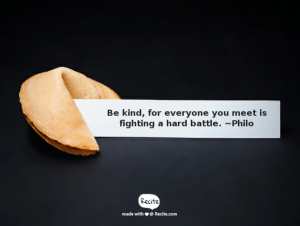
  • Display the quote below by Philo, and frequently brainstorm ways we can be kind

recite-19kvlam


Photo Credit: