The English language can be tricky. It’s a lot of “do this” and “don’t do that”, and a lot of words that are spelled the same, but have different meanings. Or, my favorite– words that sound the same, but are spelled differently and have different meanings, and that’s just how it is, because someone a long time ago made up the rules, so you have to memorize which word to use when. And then, on top of that, we have language devices that have their own rules and uses– metaphors, similes, hyperbole, oxymorons, personification, onomatopoeia, and idioms. It’s a lot to learn, a lot to remember, and can be a lot to teach.
But… even though it can be a heavy load to learn and teach, the English language can be fun. Language devices, or figurative language, specifically can be fun. They help bring writing to life and can provide depth to writing. There are a plethora of engaging activities you can do with all grade levels to teach these concepts.
Idioms can be especially fun. Kids often find the sayings funny, so it engages them. Below is a worksheet you can use with your students. It contains a list of idioms, with a place for students to write in what they think it means. The responses students give are always entertaining, and sometimes insightful.
** This download is free, and is for personal or classroom use only. Do not sell, post, or claim as your own. **
Much of what we teach our students is taught in layers, starting with foundational skills and knowledge, then we move onto the next level of difficulty, then the next, and so on. You can’t expect a preschooler to be able to do multi step equations when they are still learning to count, nor would you assume a third grader can tell you the differences between types of cells when they don’t even know what a cell is. It just wouldn’t make sense, and would lead to frustration on all sides.
Skill building is especially important when dealing with math. Sometimes as adults, we don’t realize how much we already do know, because working through the processes and methods we’ve learned is almost automatic for our brains. We know what addition is. We know what it means to make a tally mark. We understand what a graph is and how to make one.
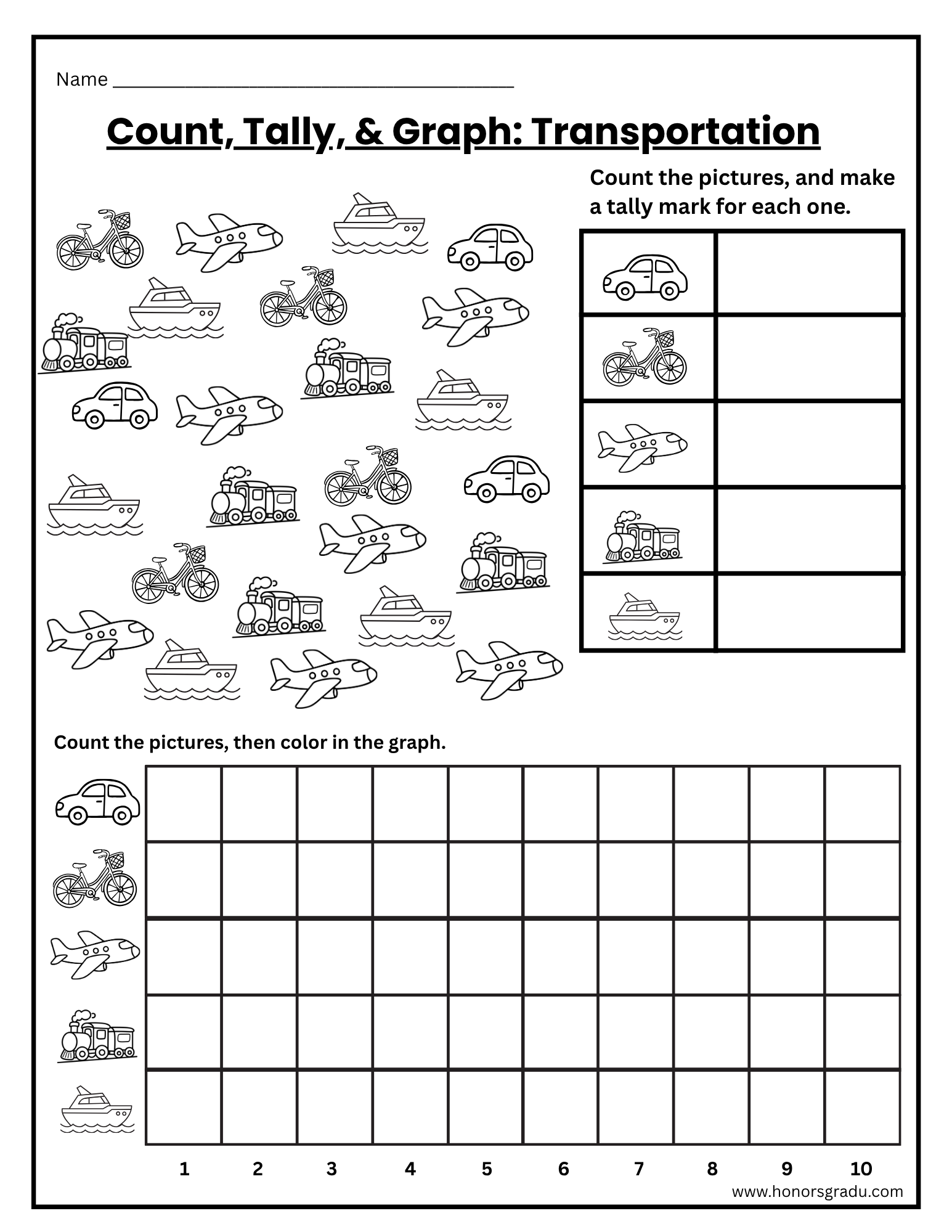
This week in preschool, my daughter learned how to count objects, tally them up, then make a graph. It is such a simple skill for my older kids (and for me), that it made me pause and realize that she’s just learning how to do those things. And you know what? That’s exciting! She’s learning new concepts and figuring out how to do things, and I love it!
So… if you teach preschool or even kindergarten, and you are working on graphing (or will be soon), I’ve got a fun worksheet you can use! Below is a download for a transportation themed Count, Tally, and Graph activity. Feel free to print it and use it in your classroom.
** This download is for classroom or personal use only. Do not sell, repost, or claim as your own. **
Today I got to help with three class Valentine’s parties. Yes, three. First, third, and fourth grades. I spent three hours at the school this afternoon, and let me tell you: my respect for elementary school teachers grew even more. But man, those kids are cute and so much fun!
While I was in each classroom, I noticed each teacher’s attention grabber– the quick little saying or line they’d call out to get their class back on track. They were all so different, but all achieved the same result. In fourth grade, I heard the teacher say, “Shark bait!”, and the class would respond with, “Ooo haha!” It worked like a charm. The third grade teacher counted down from five, and once she reached one, all the students chimed, “Thumbs up, arms folded!” In first grade, the teacher rang a quiet little bell, and all students knew that meant to stop what they were doing and stop talking. The last time I was in the kindergarten classroom, the teacher quietly said, “If you can hear me, touch your nose… ears… head, etc.”.
In all of these situations, I was amazed at how quickly the students responded to the cue. They had been well trained to know what the expectations were, and what they needed to do to meet them. I thought back to my time in the classroom, and wondered if I would have done or said anything differently. I think I probably would have tried something a little more exciting than just counting down from five, but at the time, that worked for me.
There are countless ways to get the attention of your class. Regardless of how you choose to get their attention, one thing is the same across the board: you have to train your class what the cue is and what the expectation is. If you do that, you are setting yourself up for success. Here are a few other attention grabbers I have heard:
Teacher: One, two three! Eyes on me! Students: One, two, eyes on you!
Teacher: Hocus pocus! Students: Everybody focus!
Teacher: Holy moly! Students: Guacamole!
Teacher: All set? Students: You bet!
Teacher: Flat tire! Students: Shhhhh!
Teacher: Mac and cheese! Students: Everybody freeze!
Teacher: Hear ye! Hear ye! Students: All hail the queen/king!
Teacher: Are you ready kids? Students: Aye, aye, captain!
Teacher: To infinity! Students: And beyond!
Teacher: One, two! Students: Peek-a-boo!
Teacher: Ready to rock? Students: Ready to roll!
Teacher: Chicka-chicka! Students: Boom boom!
Teacher: Scooby dooby do. Students: Where are you?
Teacher: Marco! Students: Polo!
Teacher: Eenie meeny. Students: Miney mo!
Teacher: Red Robin! Students: Yummmm!
Non-verbal cues can also work well! Ringing a bell, shaking a noise maker, or giving a hand signal can all be effective in getting your class back on track.
What are your favorite ways to get your class focused and ready to learn?
It’s no surprise that I’m a fan of holiday themed classroom fun! Valentine’s Day is just a few short weeks away, and it’s time to start thinking about some fun activities for your class to do. When we can combine fun with something educational, it’s a teacher win!
I’ve created a fun Valentine’s Day Word Unscramble that you can print off and use in your classroom or at home. Use the letters in the word “valentines” to make as many new words as you can. Use it as an individual activity or turn it into a group activity and game.
** This free resource is intended for classroom or personal use only. Do not resell, repost, or redistribute. **
January is one of those months that seems to drag on and on and on. There aren’t any big holidays to look forward to, and the weather is usually cold and dreary. As a teacher, inclement weather typically means indoor recess, and depending on your class, that could mean extra chaos. If you need something to keep your kiddos entertained in such an event, look no further! Attached below are two Winter Find & Count worksheets– one in color, and one in black and white– that you are welcome to print off and use in your classroom. (Parents, also please feel free to use in the event that the dreary January days get a little extra long and you need a quiet minute!)
** This resource is strictly for classroom or personal use. Do not resell it, repost it, or claim as your own. **
Middle grade teachers– this one’s for you! If you’re needing a quick self-starter for your students to do sometime during the first week of school, I’ve got you covered! Below you will find a free downloadable Back to School Word Scramble worksheet.
Download, print, and make some copies for your class, and just like that, you’ve got yourself a quick activity for your students to do while you take attendance. To extend the activity, you could also have them write a short story using all of the words!
**Please do not re-sell, re-post, or claim printable as your own.**