Classroom Management: A Tale of Trial & Error

Managing a room full of students can be challenging. You quickly find that what works for one student doesn’t work for another, and sometimes you feel like you are spinning in circles trying to find something that works. It can be frustrating, for sure. 

Management styles and methods vary from teacher to teacher, and can be dependent on many factors. Teacher personalities can influence the kind of management techniques that are used. Student personalities can also largely determine how a teacher manages the classroom. Another factor that definitely plays a role is the grade being taught and managed. Kindergarteners and first graders are typically going to eagerly respond to management techniques that involve silly, catchy little rhymes or actions, such as “One, Two, Three, Eyes On Me!”, sticker charts, and so on. Younger grades tend to also be very highly motivated by external motivators: give them a chance to earn a tootsie roll or a sticker, and you will grab their attention quickly! Upper elementary grades also usually respond to similar methods, but often aren’t as quick to do so. 

Secondary classes can be trickier to find successful management techniques. For the students who truly need behavior management help, offering a sticker or piece of candy probably isn’t going to do much. Forming a connection and being kind, however, will go a long way.

I recently surveyed a handful of teachers about their classroom management techniques. I found a good variety of answers and ideas. Keep reading to see what they had to say!

What is one classroom management technique that you have found great success with?

  • Connection (9th grade)
  • I have a 120 chart and kids put small sticky notes on it as they are caught being good. When the chart is full we spin a wheel for the winners! I pick 5 or 6 kids. Then we take them all off and start again! Winners get a prize from the prize box! (1st grade)
  • Focusing on positive behaviors, having a type of behavior system for individuals, groups/tables & whole class (4th grade)
  • Reinforce positive behaviors (Kindergarten)
  • Classroom money with a class store linked with prizes they actually want. (2nd grade)
  • My students absolutely love being called out for making good choices and signing a chart. Once the chart is full we do a class drawing to win prizes or other things. (3rd grade)

What is your biggest struggle with classroom management?

  • Adapting systems to each class. Every year is different! (4th grade)
  • Students unable to communicate. (9th grade)
  • When I cannot find what motivates certain kids and it seems like NOTHING works! (2nd grade)
  • It is so hard to give a consequence to a student you know will not take it well. (3rd grade)
  • Defiance- straight up telling me no. (1st grade)
  • Noise level. (Kindergarten)

What classroom management advice would you give to new teachers?

  • Consistency is key, even when you know the student might take a consequence badly. Also sometimes what’s fair for one isn’t fair for the other. It’s ok to make tweaks in expectations for students that need it. (3rd grade)
  • Have class, individual, and group systems. (Money, table points, whole class parties they work together to earn) and just know these kids are built different so it is harder! (2nd grade)
  • Connect with your kids, they will do anything for you if you form that connection from the start. Set high expectations, but give grace. (9th grade)
  • Think of your behavior management plan and then explicitly teach it to kids! State expectations clearly and then hold them to it. (4th grade)
  • Keep at it! It takes time and patience! (1st grade)
  • Keep kids busy and working. (Kindergarten)

Great advice all around! These teachers shared some great ideas as well as some encouragement– something we can all benefit from!

When it comes to finding what works for you as a teacher, it can be a lot of trial and error, and it may take some time to settle into a groove that works for you and for your class. But if there’s one thing that I’ve learned about teaching, it’s that any time spent trying to help your students be their best selves and to succeed is time well spent!

Physical Activity is Crucial for Growing Minds

There are many factors to consider when thinking about the overall well being of students in a classroom. All areas of health and well being are important— mental, emotional, social, and physical. Some are easier than others to address in a classroom setting, but all are equally crucial to a child’s well being. As teachers, it is important that we are taking time to provide opportunities for our students to grow in all areas. Physical health is an area that can be a little trickier to incorporate into a classroom, especially a secondary classroom. It’s not impossible, though! Below are some fun ideas for integrating physical movement into your classroom, regardless of the age or grade you teach. 

  • Brain breaks: Have students stand next to their desks and stretch, shake their arms and legs, or jog in place for 30 seconds. Put on a Danny Go episode and have students follow along with the actions. These kinds of quick, simple activities can help students get their wiggles out and clear their brain so that they can more easily focus on what they are being taught. 
  • Take your class outside (weather permitting) and play a relay game, such as transporting an object from one side of the field to the other. 
  • Take your class on a short walk around the perimeter of the building. If weather doesn’t allow for that, take a walk around the halls of the building, adding in the extra challenge of seeing who can be the quietest. 
  • Play PE Bingo, where each student must pick five activities to complete off their Bingo board— and the activities chosen must be in a row to create a Bingo (You can use the free resource below if you’d like.)
  • Do a “name workout”, where each letter of the alphabet is a different exercise, and students must complete the exercises for each letter of their name. (Ex: A- 5 jumping jacks, B- 30 second jog in place, C- 5 pushups, etc.)
  • Play “4 Corners”. Think of a series of multiple choice questions. On paper, create posters with A, B, C, and D on them. Place the papers in the four corners of the room. As you read each question and answer options, students must move around the room to the corner that corresponds to their response to the question. This not only creates a good opportunity for physical activity, but also helps students to see what they have in common with others in their class. 
  • For secondary students, have a class period where you play “old school” playground games— kickball, four square, hopscotch, or wall ball. You’d be surprised at how much fun teenagers have with these kinds of games (even if they put up a front that they are too old for such silliness).

Physical movement is so important for growing bodies and minds. It promotes healthy habits now and encourages kids to continue those healthy habits throughout their lives. Students of all ages need to see that all different areas of health and well being are important, and that there are simple, accessible ways to take care of each of those different areas. 

**Feel free to use the free PE Bingo card below. It is intended solely for classroom or personal use and may not be sold, reposted, or claimed as your own.**

Fun Time Fillers

One of the goals in teaching is to effectively use as much of the time as you are given. I remember one professor in college telling us to teach “bell to bell” and not waste a single minute in between. While I get the sentiment, I do think it’s okay to have some days where you do have some extra time after a lesson or in between activities. Some days extra minutes just happen— lessons go quicker than anticipated, technology problems happen and thwart your plans, or maybe the one student who is always making things take longer with disruptions is absent, so things go smoother and quicker. Whatever the reason, extra time happens, and it’s a good idea to have some time filler ideas tucked away, ready to be executed at any given time. Not sure what to do to fill time? Don’t worry! I’ve got you!

List-Maker, List-Maker, Make Me a List

Divide students into groups of 3-4. Make sure they have one piece of paper and one pen or pencil per group. Have each group designate a scribe (this position can rotate with each round). Choose a topic that is something that is familiar to everyone. Once you’ve chosen the topic, set a timer for one minute, and have groups think of as many things as they can that go with the topic. For example, if you choose “cereals” as a topic, groups would have one minute to list as many cereals as they can think of. At the end of the minute, whichever team has the most items listed wins the round. Repeat as many times as you have time for. 

Hot Potato

Have students sit on their desks or stand/sit in a circle. Choose a soft ball, stuffed animal, or wadded up piece of paper. Play a song and have students toss the object from one person to the next as quickly as possible. Stop the music at a random time, and whoever has the object when the music stops is out for the rest of the round. Continue until there is only one student left standing. Be sure to set up safety and fairness rules to ensure that everyone is playing kindly, safely, and fairly. 

Magic Words

Divide students into small groups (2-3 per group works best), and give each group a piece of paper and something to write with. Give the class a word, preferably a longer one, and set a timer for however long you want— the shorter the time, though, the more of a challenge it becomes. Students have the allotted time to use the letters of the given word to find other words. For example, say you give the class the word “watermelon”. They would then use the letters in that word to make new words, like water, melon, wait, neat, lemon, rate, etc. They must be real words, and must be spelled correctly. Whichever team has the most words by the end of the time wins the round.

A Letter and Some Categories

Again, divide the class into small groups. One the board, list five or so categories— things like countries, animals, fruits, cities, car makes, etc. Set a timer for a time of your choice, make sure each group has paper and something to write with, then give the class a letter of the alphabet. In the time given, groups must think of something for each category that begins with the letter they were given. For example, if you gave them the letter B and the categories listed above, one group’s response could look like Bolivia, bear, banana, Baltimore, and BMW. Repeat with different letters. 

Rhyme Time

As before, divide the class into small groups. Make sure each group has a piece of paper and something to write with. Set a timer, and give the class a word that can easily be rhymed with. In the given time, groups must generate a list of as many words as they can think of that rhyme with the word they were given. 

These ideas are all super simple, require no prep time, and can be done with any size of class. While some might see these games as a waste of time, all of them— with maybe the exception of Hot Potato— require students to think quickly, work together, and think about a specific category or set of rules. So really, they aren’t a waste of time, but rather a fun, engaging way to fill a few minutes while strengthening thinking and social skills. And that, my friends, is a win in my book!

Classroom Desks: Do they really matter?

One of the most essential parts of a classroom is the desks. Students need somewhere to sit while they learn, and they usually need some kind of surface to use for working. Desk type and arrangement can play a big part in learning and student success. In a science classroom where students are going to be working together to do experiments and other projects, single desks may not be the best option. In a history classroom, where students will be mostly working independently, individual desks are probably the best choice. In a college classroom, where lectures are often taught in large auditorium type rooms, it’s beneficial to have seats with folding desks. Whatever the case may be, desks are crucial to a classroom. Let’s dive into some of the different types of desks.

First, we have a traditional open front or top-lifting desk and chair. These desks are great for elementary aged classes where students stay in one room for most of their subjects, as students can store their school supplies in their own desk. Typically, these kinds of desks have a free standing chair that is not attached to the desk itself. This is great for easily rearranging desks into any configuration that might be beneficial for the teacher and students. It also makes for easy cleaning for the custodial crew, as the chairs can be stacked at the end of the day. The in-desk storage is also a nice feature for students who are going to be in the same classroom all day. It gives them a place to store their things and have a little personal spot of their own. 

Second, there is the single desk with a chair attached. This type of desk usually doesn’t have storage options, and is often found in secondary classrooms. These desks are often cumbersome, as the chair and desk are all once piece. Moving these types of desks is a pain, and trying to figure out an arrangement with them can be tricky. They work great for teachers who don’t want to deal with chairs and desks all over their room. One downside to this type of desk is that they aren’t very “user friendly” for students who are taller, have smaller body types, or have larger body types, as they can’t adjust how closely (or how far away) they sit to the desk. 

Next, we have tables and chairs. These can usually fit 2-3 students a piece, and are ideal for science, art, or other creation type classes. They offer ample space for writing, working, and doing experiments and other projects. They allow for students to easily work together. They are, however, more cumbersome, and don’t allow for as many seating arrangements. 

Lastly, there are the chairs that have folding desks attached to them. These desks are great for college classes where space is limited and no storage is needed. However, they don’t offer a ton of surface space for writing and working. This can get tricky if a student needs to have a computer, notepad, and textbook out at the same time: there just wouldn’t be enough space to hold everything. 

Obviously, these are not the only types of desks that can be found. These ones, however, are the most common. Picking the type of desk for your classroom is an important aspect of student learning and engagement. What kind of desks do you have in your classroom, or what is your favorite type of desk for students to use?

The Child Whisperer: Type Three

This post is part of a series on The Child Whisperer and using it in the classroom. To see more, head here.

Alright, it’s time to talk about Type Three of the child whisperer! For The Child Whisperer types, it’s important to remember that this is not just personality typing, it’s channeling in on a child’s energy and how they use their energy. Most everyone has all four types in them, but one or two shine through the most in the majority of situations. 

Type three is typically known as “The Determined Child.” A type three’s primary connection to the world is through being physical in some way, and their primary need is to have support from loved ones as they experience new things. 

Words that describe type two: busy, physical, energetic, forward thinkers.  

Tips for teaching a type three: 

Consistency is huge for a type three child. And so is pushing them out of their comfort zone! They may take some coaxing sometimes, but typically once they are given the support to try something new or big, they take off with it and shoot for the stars! 

Oftentimes a type three child can forget who is in charge and need to be reminded. Their big, bold personalities take over and they try to step in and take charge when they can. 

They will be your students rushing through work and then buzzing off to the next assignment, task, or even next activity that might get them in trouble! Staying busy is what they need most, even if they cannot communicate that to you. 

Do you have a type three child in your classroom? What have you learned through teaching this type of student? 

The Power of Asking: Creating Classroom Resources

Being a teacher means one absolute- paying for your own supplies. It is no secret that there are teachers across the nation paying out of pocket for staplers, books, and more. But what if it didn’t have to be that way? What if there was a way we as teachers could find our own resources, but not pay out of pocket? What if I told you there is ONE simple way you could have access to copious amounts of supplies without spending a dime? Because there is a way, and it really can be simple. Here it is.

Ask. 

Asking for donations and supplies can be scary, scary enough that many don’t go this route. The way I like to look at it is, what is the worst that could happen? They tell you no? But let’s break it down- who do you ask, and how do you ask? 

Who- This comes with endless possibilities. Ask your principal, see what the school can offer you. Maybe they have staples and sticky notes and really cool classroom sets of books lying around that never get used because no one ever asked! 

Parents- Some parents may not want to contribute their time, money, or resources to your classroom, and that is fine! Others may not have the means do to so. That’s okay too. But there are also parents out there who can and will support you how you need, you may just need to ask. 

Friends and family- It might surprise you how willing people are to chip in a few dollars here or there to your classroom. Amazon Wishlists and DonorsChoose.org are great resources for sharing what your wants and needs are in a classroom, giving others the option to help fund and support those wants and needs. My dear friend Danielle Macias has been a great example of asking friends and family for support of her classrooms by sharing a donors choose platform when she has a need. She said,
   

“I’ve learned that social media, especially Twitter, can be a great platform to share any projects I may need help with. There are also many donors who are willing to help if you know whom to ask. I would advise teachers to familiarize themselves with Twitter hashtags like #clearthelist and join Donors Choose FB group. (Teachers need to make sure that it’s okay with their district.) I would also advise that teachers promote their donors to choose projects when there’s a promotion to increase their chances of getting funded.” 

Danielle was able to raise money to fund a classroom set of books and headphones. The options and possibilities can be endless if we do one simple thing- ask. 

How have you obtained classroom resources on a budget? 

Why I Decided The Clip Chart Wasn’t For Me

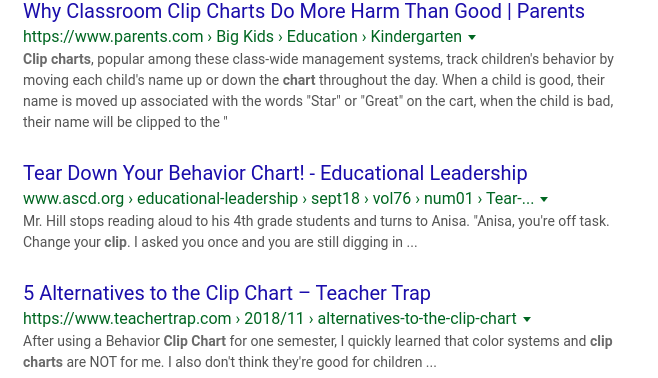
Oh, the dreaded clip chart. You know the one I’m talking about. “So-and-so” is being great! Move your clip up! Oh, Jonny, that wasn’t appropriate! Move your clip down!” It’s no secret that teachers have become outraged by these classroom management resources. One quick google search will show you just how unpopular they are. 

The first three articles to come up when googling “Clip Chart”

The first day I walked into the classroom of my long term sub job, I noticed one thing right away on the whiteboard- a clip chart. The public humiliation display. The does-more-harm-than-good tool. I did my best effort to keep the clip chart during my first week taking over the classroom, but I soon realized why it didn’t work. 

  • It was used for negative reinforcement more often than positive reinforcement. It was easier to use it for students misbehaving than to remember to reward those that were behaving. 
  • It didn’t change the behavior of the students who were constantly dropping into the negative. They quickly became numb to it, they didn’t care about moving their clip down, or up for that matter. 
  • I felt like our whole day revolved around the chart. Because I realized how often it was used for the misbehaving kids, I put in extra effort to use it to praise students for good behavior. It took too much time and effort. The best way to manage a classroom is to have an effortless, mindless, mostly positive plan in place. I needed a classroom management plan that was easy and natural for our classroom. 

So what did I do once I realized it wasn’t working? I stopped using it, slowly over time. I moved clips less and less, never making it a big deal or a spectacle that the clip chart was non-existent. I forgot about it and so did the kids. In fact, not a single student ever asked about it after we had fully stopped using it. Even the star students that were always at the top every day didn’t mind me phasing it out, no one wanted their behavior displayed to the entire classroom, including all of our visitors. 

Here’s what we did instead. We started our money unit, so a coin system was easily put in place. Each student had a container for their money and was solely responsible for it. Not very often was I taking pennies from the students, it was used more for positive reinforcement, which made everyone happier. It was incredible the drive the students had to clean up the floor at the end of the day when I would announce, “I have one nickel for every student who brings me ten pieces of trash!” I think we could have won awards for how clean our classroom was each afternoon. The money earned was used to pay for extra bathroom trips, new pencils, and a teacher store at the end of the year. 

We did a group point system on the board. I numbered each group, wrote the numbers on the board, and gave them points for being on time as a team, working together, and having their whole table quiet and ready to learn. It promoted teamwork and gave them an incentive to do better.

What did the point system on the board go towards? Here’s the magic of it- nothing. The points went towards nothing. Once the tallies made it to roughly 10 points per team, I would erase and start over. They were working hard simply for tallies on the board! I had one student ask quietly what the tallies were for. There were plenty of other side conversations happening at the time, so I chose to focus my attention elsewhere. I never heard any questions again after that one incident. 

Since I was teaching first-grade students, passing around a tiny sticker to hard workers was a huge motivation for them. I also kept a box of Cheerios in my cupboard to pass around one Cheerio to quiet, on-task students. After one or two times of doing this, they learned fast. As soon as the box was in my hand to pass them out, every student would be working hard. It amazed me how motivating one piece of cereal can be. 

Clip charts clearly are not a classroom management win. It may work for some and could possibly be excellent personal behavior management tucked away in a desk for one or two students that need it. But as a whole class approach, there are better options out there. Positive reinforcement has been proven to be the most effective for changing behavior, and clip charts do not promote this. Let’s all take a minute to put down the clip chart and pick up a more positive approach for our student’s sake.