10 Meaningful Student Self-Assessments: A Pinterest Curation


With an abundance of clever crafts, cute bulletin boards, and coordinated decor, Pinterest generates much that is adorable in classrooms. But the meatier stuff is out there, too–if you dig a little deeper. Below are 10 Pins to brainstorm better self-assessments for your students.

#1: Create a hard working turn-in system:

cbc3b7f90fd2288fb863e4cabe00502d

 (also, a file folder version)

#2: Practice Visible Thinking Routines together:

3759e67963de791a701b11126ca2544f

#3: Evaluate Personal peer teaching level: 

d7ae5ef83176df2eddd5c59ae63fb2e1

#4: Take exit tickets to a new level: 

7fdff6b83f8a6da0f8111470f14c66dc

#5: Reflect on IB Learner Portfolios for End of Unit: 

d28f77e43d80904147a6bc081c7f0463

#6: Cultivate networking & smart peer tutoring:

c5d3c78b9be4825f3ebed7532f29dae6

#7: Structure Authentic Student Analysis of Reading Fluency: 

d0631515e41ff0607f247435cc96f097

#8: Lend words for reflecting on personal emotional well-being:

d12e4f03585caf9f07bd81deeeae3783

#9: Lay out guidelines for a Writing journal snapshot assessment: 

934ea698255c26248723a622ee4f8f8e

#10: Design a Student led conference survey:

73dd6cb28fd380ed2b5d56d8f7a113ee

(after all, you know how we feel about student-led conferences…)

And WHATEVER you do, PLEASE don’t let your assessments ever resemble this: 

9984dc650cd83745344fb0ae41333706

What are your favorite self-assessments? How about your most outstanding Pinterest boards on teaching? We’d love to hear them!

Featured image: DeathtotheStockPhoto

Daily First Impressions: How to Maximize the First 5 Minutes

Insufficient sleep, lack of breakfast, trouble with parents–there are a lot of reasons students may enter class with less-than-chipper attitudes in the morning. And while we should encourage them to take charge of their own mindsets, we should also consider empathy as we design the first 5 minutes of each day.

So in those first few pivotal minutes, let’s consider how we are setting the climate for the day. Do we orient the students into an atmosphere of meaningful connections? Do we remind them that their contributions matter here? Do we set the tone of shared ownership and responsibility for learning?

Suggestions:

Class mini-meeting:

If a 30+ minute weekly class meeting isn’t in the cards with your schedule, consider holding condensed mini-meetings each morning, pulling out just the essentials like High-Lows,  essential announcements & changes to the schedule, or a quick Talking Circle.

Read aloud:

We are going to defy the many discussion threads on, “When is my child too old for picture books?” by declaring NEVER! No matter what grade you teach, you will not go amiss by starting class with a quality picture book. Not only are they full of essential life-lessons and values, but they’d also be a great incentive for kids to come to class on time!

Recap Yesterday:

Especially useful if your schedule prevents a solid wrap-up the day before. Activate the discoveries, concepts, and difficulties from yesterday by using strategies like visual thinking routines (we find “Compass Points” or “Used to Think” especially intriguing for this purpose).

PZ Thinking Routines from Sue Borchardt on Vimeo.

Logistical Tips:

Keep the morning routine student-centered:

• Instead of taking roll, create a check-in board where students move clothespins, magnets, or pocket chart cards labeled with their names or numbers

• Instead of calling out for hands for who is ordering hot lunch, make the check-in dual-purpose by adding lunch choices, like in the example below: 

via Pinterest
via Pinterest
Keep it well-oiled:

• Model clear and high expectations for the start of class–if you spend the first few minutes double-checking your email or making last-minute preparations, the students will follow suit. Instead, model readiness and enthusiasm to start right away!

• Take the time to teach and then occasionally practice the morning routine expectations. For instance, you might teach them the following routine:

• Hang backpacks, make lunch choices, unstack chairs, turn in papers, and gather at the rug (if you’re doing a read aloud, start reading as soon as you have greeted each student at the door to help encourage them to join you quickly).


Prioritize and Strategize:

• Sometimes, we come across pet activities that can distract us from what will matter most for students’ present and longterm self-driven learning.  We must honestly evaluate them for their authentic learning value for students, especially when placed next to other possibly more worthy ventures. Some culprits may include:

» Having students write down your entire week’s worth of plans in their planners

» Logic puzzles–especially when it’s almost always of the same variety (Pretty sure my fifth grade teacher made us to Hink-Pinks every morning of the school year)

» Arbitrary worksheets

• For those self-starters that may be completely non-negotiable, such as math fluency practice, strategize the timing. Is first thing in the morning really the optimal time for that practice, or could there be a better time when students are more alert and ready?


As we work to start each day with more purpose, we, along with our students, will more clearly glimpse the big picture of what matters most for our learning throughout each day.

What about you? What morning routines and strategies help you and your students start each day out right?


Featured image: DeathtotheStockPhoto.com


High-Lows: Highlighting the Human Experience

High-lows is a simple ritual of sharing our high and low moments each day. It can strengthen your student rapport, inform you of your classroom climate, and offer closure each day–all in less than 5 minutes!

The Human Factor

In the bustle of standards, projects, and assessments, do you give students time to step back and reflect? Do you encourage them to consider their personal responses to the various learning experiences each day? Do you encourage them to vocalize their emotional state in appropriate ways? And do you model all this YOURSELF?

Theories & Goals of educationHigh-lows is a tangible way for us to consider our students as human beings–and for them to view us as such, as well. Spending just a few minutes on this at the end of each day has taught me about my students’ interests, disappointments, priorities, and delights. My students in turn became familiar with what I consider to be moments of triumph or frustration–which gave them insight into my learning process as a teacher.  

Better understanding one another on such an honest, human level enhanced our mutual trust, communication, and respect. 

Tips

  • Spend the last couple minutes of the day (often wasted on door loitering anyway) with high-lows.
  • Introduce high-lows by modeling your own high-lows from teaching that day (“My high was during social studies today because the questions many of you asked were so inspiring and deep! My low was math because I felt like I spent too much time talking and not enough time letting you guys practice–I’ll be fixing that tomorrow, though!”). Feel free to occasionally share non-teaching high-lows when appropriate, too (“My high was when I found out my daughter will be my sister’s flower girl in her wedding! My low was taking my dog to the vet last night.”).
  • Model sharing your why for both highs and lows.
  • Keep the lows honest but light. Tell students that we should never give names, or even situations that could point to an individual who frustrated us. For an outlet for students to voice personal concerns, consider an alternative like a suggestion box.

What are other ways you show your students you consider them to be human beings?

featured image: Death to the Stock Photo

Why & How to Abolish “Can I Go to the Bathroom?”

The way we handle one of our students’ most basic needs can reflect a lot about the degree to which we cling to control. Not only does this topic take a lot of honest self evaluation, but it requires genuine empathy for each of our students.

Why?

unnecessary interruption

When students are required to raise their hand to ask to use the bathroom, it often disrupts the flow of a discussion.  And with intercom announcements, drills, and more, don’t we have enough interruptions anyway? 

Domino effect

Particularly with younger students, a restroom announcement from one student often triggers several more deciding to go unnecessarily. This turns a simple, individual routine into a larger disruption to learning.

humiliation factor

We probably don’t need to list all the circumstances that may require a person to visit the bathroom more frequently than others.  And because those circumstances are often deeply personal and sometimes embarrassing, forcing students to raise their hand each and every time can be humiliating for some, and perhaps debilitating for others.  Students have enough on their shoulders without the added anxiety of whether they’ll be able to discreetly take care of their bodily functions.

Student autonomy


We often worry so much about our responsibility as teachers to keep tabs on all our students that we lose sight of their capacity. However, with some training and discussion, the majority of our students can handle the simple social contract of only using the restroom when needed, and to monitor appropriate timing to do so.  If you’re worried about them getting up in the middle of instruction, tell them that. Explain the concern that they will miss important instructions, and encourage them to utilize independent or group work time. Explain the privilege and associated accountability with this autonomy. And of course, continue to keep an eye out to pick up on misuse and possible intervention. See ideas for this in the tips below.

Put yourself in their shoes

We may think we’re teaching them responsibility to check in with you first. We may think we’re teaching them time management to tell them to just go during their breaks. But in the end, we must honestly ask ourselves the tough questions: how would we feel to work in an environment where we had to check in with someone each time we needed to go?  How would our concentration be impacted? What messages are we sending to our students when we strictly control their bathroom use?

How?

  • If you’re coming from a place of more thorough bathroom-use monitoring, start by opening up the conversation with your students. Arrange a class meeting and ask students how they would feel about a new bathroom procedure that allows them to take care of things without coming to you. Discuss the functions of trust, responsibility, and safety, both during that meeting, and throughout the year.
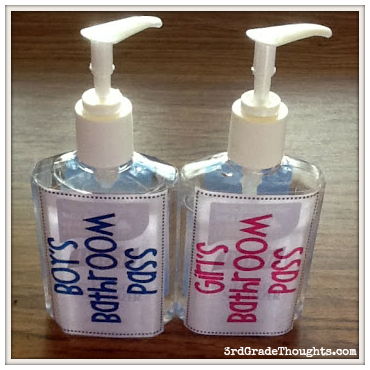
  • Set alternative requirements that will still fulfill your responsibilities as a teacher.  For instance, stipulate that students must put an object on their desks, such as a bottle of hand sanitizer, to indicate they have left (win-win). Another idea is to further require that only one boy and one girl may be absent simultaneously to avoid group bathroom hangouts.  
via 3rdGradeThoughts
  • Really ask yourself, is one of  your main worries that they’re going to the bathroom just to escape? If so, ponder what you can do about your classroom environment or practices to make your room a more desirable place to be.
  • For students who are accustomed to total teacher control, they may view this new privilege as a continuation of the “me vs. teachers” game they’ve learned.  If this happens, work with that individual student, reminding him or her about trust.  You may find it necessary to create an individual system for that one student (small check-out sheet, etc), but make sure you do not punish the entire class for the lack of responsibility of just a couple students.

featured image: Sam Breach

8 Tips For Non-Manipulative Classroom Praise

“Praise, like penicillin, must not be administered haphazardly. There are rules and cautions that govern the handling of potent medicines— rules about timing and dosage, cautions about possible allergic reactions.” (Haim Ginott, 1965, p. 39)

Praise Research 

Praise researchers have set up various camps for decades. Some maintain that praise encourages student behavior and motivation, advising teachers to “reward the student with verbal reinforcement when she or he exhibits desired behavior” (Dev, 1997, p 16). 

Others believe that it can damage motivation–and in some cases, even become downright manipulative. Alfie Kohn contends that praise “leads [students] to measure their worth in terms of what will lead us to smile and dole out some more approval” (5 Reasons to Stop Saying Good Job).  They argue that “Praise can create excessive pressure to continue performing well, discourage risk taking, and reduce perceived autonomy.” (Henderlong, J. & Lepper, M.R. “The Effects of Praise on Children’s Intrinsic Motivation: A Review and Synthesis,” p. 776).

Despite these opposing camps, still other researchers examine specific variables of praise that can impact students’ intrinsic motivation both beneficially and detrimentally. In their comprehensive praise review, Henderlong and Lepper conclude, “rather than asking whether praise enhances intrinsic motivation, it is far more useful to ask about the conditions under which this is likely to occur” (The Effects of Praise, p. 791). Some of those conditions include:

  • Sincerity: honest and specific evaluation
  • Performance Attributions: focusing on controllable processes vs. student ability/overly simple tasks
  • Perceived Autonomy: focusing on students’ autonomy vs. our control (finding, in fact, that no praise has a better effect than controlling praise)
  • Competence and Self-Efficacy: focusing on information on performance vs. social comparison
  • Standards & Expectations: focusing on specific praise on appropriately-challenging tasks vs. praise for too-easy or too-difficult tasks

8 Tips

Be mindful of the growth-mindset

Never praise students for what they are right now. Elevate your sights to the vision of where their efforts can take them; if your praise focuses merely on their current abilities, they will be less likely to view that potential for growth in themselves.

“I could tell you worked so hard to figure out that math problem. Way to stick with it even when it was tricky!” instead of “You’re so good at math!”

Be descriptive

Vague statements like “good job” can undermine student motivation because it does not offer concrete support for a student’s effort, nor does it recognize their personal reasons for pursuing the task. On the other hand, a detailed description becomes more useful feedback.

“Nice–when you made eye contact and responded constructively to your group members during that activity, it showed them respect and helped your whole group have a good discussion.” instead of “Good group discussion!”

Make the positive reinforcement more of an observation than explicit praise.

Set the tone of optimism by noticing the good more often than the bad. This helps create a positive atmosphere not only because students know you’re not going to harp on every error, but also because they’ll tend to pay more attention to the good things happening around them, too.

“I notice that Carlos is stacking everyone else’s chairs for them.” 

Connect the praise to genuine principles of respectful relationships.

Really, everything else hinges on this one. As Henderlong and Lepper concluded, “…provided that it is perceived as sincere, praise is likely to enhance intrinsic motivation when attributional messages prevent maladaptive inferences, when autonomy is promoted, when perceived competence and self-efficacy are heightened without undue use of social comparison, and when realistic standards and expectations are conveyed” (The Effects of Praise, p. 791). Nothing else will quite matter if your students sense ulterior motives.

“Wow, when Becca turned her chair around when I was sharing instructions, I could tell she was offering not just her attention, but her respect for my time, because her body language showed it. I really appreciate that.”

Genuinely thank students for their efforts to create a supportive classroom environment

They should know that you understand that it’s not easy to bring 25+ people together in a cooperative, positive, and safe learning environment every day. Give them the tools to help by verbalizing the kinds of choices that support learning.  Express your appreciation for those efforts frequently, reminding them that we’re all in this together!

“When Johnny was sharing his story, I saw Ashley put down her papers and look up at him. It’s not easy for anyone to get up and share, so thank you for helping Johnny feel more comfortable with sharing with such an attentive and respectful audience!” 

Don’t just use positive reinforcement as a misbehavior redirect

Notice and point out times when the entire class is pitching in to help the classroom run smoothly, and explain the difference you can feel–and ask them if they can feel it, too!

“During that transition, everyone put away the math cubes and moved back to their desks for wrap up immediately! I love that we have plenty of time to discuss our math noticings now–thank you for helping our class run smoothly!” 

Notice everyone

Seriously. Use a class list on a clipboard and tally off names if you need to. Otherwise, you and your students both know you’re going to wind up primarily noticing the same 5 line-of-sight people every day.

Get rid of tangible extrinsic rewards that often accompany praise

These devalue the positive attention given because students are less likely to internalize the value of the behavior or task for its own sake.  Keep close tabs on your extrinsic rewards in general, and always be willing to ask yourself the tough questions.

Featured Image: fs999

10 Back-to-School Icebreaker Games

Icebreakers aren’t just fun–they can play an essential role in helping your students become comfortable with each other at the beginning of and throughout the school year. They also have serious potential for team-building, bonding, and concentration!  This is a tried-and-true list of beloved games, especially suitable for upper elementary and older grades.

7/28/15: As you make plans on how to use this list, check out my follow-up post: Icebreakers: A Learning Moment & Follow-Up


Game of Whiz:

Description: This icebreaker is sure to help everyone get comfortable with each other and have fun as they play with sound effects.

[bg_faq_start]

Instructions:
  • Everyone stands in a circle facing each other.
  • Pick a person for the first turn.  He or she can pass the turn by doing one of the following actions/sounds:
  • Saying, “Whiz,” while turning with hands extended as if passing an object to the person on the right or left only.
  • Saying, “Sha-na-na-na-na-na-na,” while waving arms like tentacles across the circle to someone else (make eye contact so they know who you are passing the turn to!)  Note: The person across the circle has to receive the turn by saying “Sha-na-na-na-na-na-na” back at the passer before passing the turn to someone else!
  • Yelling, “Ahhhh!” while putting palms together and pointing at a new person. Note: The person across the circle has to receive the turn by yelling “Ahhh” back at the passer while putting their palms together above their head before passing the turn to someone else.
  • If someone tries to pass “Whiz” to you, you can also deflect it by putting your palms out and saying, “Boink!” Then that person has to pass the turn the other direction (“Boink” only allowed with “Whiz.”)
Winning:
  • After a couple of practice rounds, you can try elimination, where people get out if they forget to receive the “Sha-na-na’s” or yells properly, or otherwise mess up.
  • The last two people standing win!

[bg_faq_end]

Hoi Game:

Description: Another great icebreaker that allows everyone to just be silly and have fun together as they train with their “samurai sword” hands, drilling, “Hoi!” at each other.

[bg_faq_start]

Instructions:
  • Everyone stands in a circle facing each other.
  • Everyone puts their hands together as if in samurai training and bows to each other chanting, “Hoi, hoi, hoi, hoi, hoi.”
  • Then the first person puts their palms together with arms extended, and while pointing them at someone says, “Hoi!”
  • The person who was pointed at has to respond by putting his/her hands above his/her head with palms together while saying, “Hoi!”
  • The two people standing on either side of the person pointed at also put their palms together and slash at that person’s torso (without actual contact), saying, “Hoi!”
  • After their neighbors slash and say hoi, the person with their hands above the head then drops them in front, pointing at a new person, and saying, “Hoi!”
Winning:
  • After a couple of practice rounds, you can try elimination, where people are out if they say “hoi” out of turn, lose the beat, or motion their hands in the wrong way.
  • When you get to the last two people, the leader can have them stand back to back, walk 5 paces, and then turn and “hoi” at each other–the first to say it & point wins!

[bg_faq_end]

Assassin

Description: This game takes serious observations skills as everyone pretends to be diplomats at an international conference, mingling among an assassin!

[bg_faq_start]

Instructions:
  • Everyone stands in a circle facing out (no peeking!)
  • The leader is in the center and walks among them, talking about random topics to serve as a distraction as to who they choose as the assassin. The leader taps one person on the shoulder twice, designating him or her as the assassin, and continues to walk and talk a bit to keep anyone from knowing the assassin’s identity.
  • The leader tells everyone to turn and then mingle as if they’re at an international conference.  They should shake hands while saying hello in another language (Variations: leader can tell everyone to greet each other as an animal, or in an accent, etc.).
  • The assassin mingles, too, and intermittently kills people as they shake hands by squeezing someone’s hand twice.
  • Once their hand has been squeezed twice, a person should fall to the ground and faint or die as dramatically as possible.
Winning:
  • As people begin to notice a pattern, someone can raise their hand and shout, “I have an accusation to make!” Someone else has to say, “I second the accusation” for the person to make the accusation–if no one seconds it, they die.  If someone seconds it, the leader counts to three, and then the two people have to point at the accused assassin.  They must point at the same person! If they disagree, they both die.
  • If they both point at the same person, and that person is the assassin, they win. If they both point at the same person, and it’s not the assassin, they both die.

[bg_faq_end]

Carriwitchet

Description: This is a variation of the popular game, “Fruit basket.” Only instead of calling out fruits, the person in the middle calls out get-to-know-you descriptions!

[bg_faq_start]

Instructions:
  • Everyone stands in a circle facing in on a place marker (or sitting on their chairs).
  • The person who starts out as “it” stands in the middle without a place marker, and calls out “Carriwitchet if you have        [person shares something about themselves or something they’ve done]!”
  • Everyone who has also done that thing or who shares the description has to find a new place marker. When switching, you must find a place at least 2 place markers away.
  • The person in the middle runs to a place marker, and the last person without a place marker is the new “it” in the middle.

[bg_faq_end]

Concentration

Description: This is a great clap/chant game to help get everyone in rhythm and unified! It’s also fun to see how many words for each topic the group can come up with.  It is a trickier game to get used to, though, so make sure you have plenty of time for everyone to practice the beat!

[bg_faq_start]

Instructions:
  • Everyone sits in a circle facing in.
  • The leader starts everyone off in the clap/snap/chant pattern as follows:
Opening Verse spoken by all: Subject-choosing verse spoken by leader while everyone continues the hand rhythm
  • “CON- (pat legs)
  • -CEN- (clap hands)
  • -TRA- (snap with one hand)
  • -TION, (snap with the other hand)
  • Concen- (pat)
  • -tration (clap)
  • Is the (snap)
  • game. (snap)
  • Keep (pat)
  • the (clap)
  • rhy- (snap)
  • -thm, (snap)
  • keep the (pat)
  • rhythm (clap)
  • to the (snap)
  • end.” (snap)
  • (pat legs)
  • (clap hands)
  • “Subject (snap with one hand)
  • is (snap with the other hand)
  • (pat)
  • (clap)
  • [states subject] (snap)
  • (snap)
  • (pat)
  • (clap)
  • Starting (snap)
  • with  (snap)
  • (pat)
  • (clap)
  • [states example] (snap)
  • (snap)
  • Ideas for subjects:
  • fruits, desserts, cereals, sports, school, summer, animals
  • When you state your example, it must be on the snaps! If it’s more than one syllable, you can say it over both snaps, but it cannot be spoken with the pat/clap.
  • Everyone goes counterclockwise around the circle from the leader stating an example of the subject when it is their turn.
  • NO repeated examples!
Winning:
  • After a few practice rounds, you can try elimination. If a person can’t think of something on their turn, says their example off-rhythm, or repeats an example someone else already said, they are out!

[bg_faq_end]

Big Booty

Description: This is a classic concentration rhythm game, where everyone tries to get the Big Booty out!

[bg_faq_start]

Instructions:
  • Everyone sits in a circle facing in.
  • The leader is “Big Booty,” and then everyone else numbers off counterclockwise, starting at 1.
  • Everyone puts their hands in the air and says, the following:
    • “Ahhh, Big–”
    • BOO-ty, (pat). They start a simple pat/clap pattern.
    • Big BOOty, (clap on “boo”)
    • Big BOOty. (pat on “boo”)
    • (clap)
    • Big Booty, (pat)
    • Number __ (clap)
    • (pat)
    • (clap)
  • Big Booty starts off by passing his/her turn by saying their own title, and then someone else’s number.
  • One pat/clap beat in between turns.
  • The person whose number is spoken then receives the turn by saying their number and then passes it by saying someone else’s number, or “Big Booty.”
Winning:
  • After a few practice rounds, you can try elimination.  If someone doesn’t receive their turn by saying their own number first, missing the beat, or responding when it’s not their turn, they are out.
  • When someone gets out, they go the end of the numbers (to the right of Big Booty), and everyone numbers off, starting at 1, to the left of Big Booty.
  • The goal is to get Big Booty out  and to become Big Booty yourself!

[bg_faq_end]

Captain’s Coming (source)

Description: This is a silly version of Simon Says that gets everyone scrambling to follow the captain’s orders!

[bg_faq_start]

Instructions:
  • The leader is the captain, and is in charge of calling out actions and refereeing
  • Actions to be called out:
    • “Captain’s Coming!” (1-person command): Everyone stands at attention with their hand in salute, and they can’t move until the captain says, “At Ease!”  If the captain calls other actions before saying, “at ease,” and people move to do them, they are out!
    • “Man Overboard!” (2-person command): One person drops to one knee the other stands behind them, puts a hand on their shoulder. Both put their hands above their eyes to look for the man overboard.
    • “Crow’s Nest!” (3-person command): Three players stand with their backs toward each other and link elbows, forming a crow’s nest.
    • “Mess Table!” (4-person command): Four players huddle around a make-believe table and pretend to eat savagely, making sounds like, “NOM-NOM-NOM-NOM!!”
    • “Walk the Plank!” (5-person command): Five people stand in a single file row hands on the shoulders of person in front of them.  The captain comes and counts out five, starting with the person at the front, but people can keep trying to shuffle into the front of a line of 5 to get included in the plank until the captain starts counting.
    • “Mermaid!” (optional 1-person command to get everyone cracking up): Players each thrust out the right hips, puts the right hand on that hip, and makes an exaggerated tail wave with the left hand, yelling, “Howdy, sailor!”
  • The captain should revisit “captain’s coming” from time to time to see if everyone is paying attention with “at ease.”
Winning:
  • Everyone has to get in groups, doing the correct actions within a few seconds, or the captain declares them out!

[bg_faq_end]

Crabwalk Shoe-Tag

Description: This is a great rainy-day indoor game that gets everyone moving and having fun.

[bg_faq_start]

Instructions:
  • The leader sets up a rectangular perimeter with markers.
  • Everyone loosens their shoelaces or shoe straps and then gets into a crabwalk position on all fours.
  • When the leader says, “Go,” everyone crabwalks around trying to knock off each other’s shoes.
Winning:
  • Last one wearing a shoe wins. 🙂

[bg_faq_end]

Two Truths & a Lie

Description: This game is a great way to learn about each other–not only the things that people have done, but how good they are at being sneaky. 🙂

[bg_faq_start]

Instructions:
  • Everyone thinks of two true things they have done and one thing they have NOT done. (for younger students, you might even have them write down their ideas.  You may also want to teach them about what makes it fun; saying, “I have 1 brother, I have 2 brothers, I have 2 uncles,” isn’t a particularly interesting one for anyone to guess, which is partly why we emphasize telling them to share things they’ve done).
  • Other players take a few turns guessing which is the lie, before the person reveals it!
Winning:
  • The person who correctly guesses the lie gets the next turn!

[bg_faq_end]

Never Have I Ever

Description: This is another classic get-to-know-you game that my students always enjoyed playing in the hallways while waiting for the next activity!

[bg_faq_start]

Instructions:
  • Everyone puts 5 fingers in the air.
  • The  person whose turn it is says, “Never have I ever ___(something they have honestly never done that they think other people have done)___.”
  • Anyone who HAS done it must put down one finger.
Winning:
  • The person who still has at least one finger up wins!

[bg_faq_end]

Photo Source

Antoinette van de Rieth (featured image)

How to Set up Democratic Classroom Jobs

When you set up your classroom, is democracy a mindful priority?

Background

I’ve never forgotten the story of how one of my favorite college professors was begged out of retirement to teach 2nd grade–the evening before school started. When she walked into her classroom on the first day of school, it was to bare walls, stacked desks, and puzzled students.

They sat down on the floor together. Eventually, a 7 year-old timidly shared that things felt a little off, to which the others agreed.  When my professor asked them what a classroom should consist of, one girl raised her hand and said, “Well, last year, we had chairs.” They set to work arranging the furniture, and then regrouped. Then, another boy offered, “We also normally have pencils.” Together, they procured a supply.  And so it went for the first part of the school year.

I’ve always remembered the ending to her story: that those students owned that classroom as none of her students had before or since. And with a wink, she added that she didn’t necessarily recommend having zero preparation before the school year started–at least for the sake of school administrators’ sanity.

The Set Up

The idea of incorporating classroom jobs centers around ownership. This is more than about classroom management or clean-up–it’s about empowering students with the understanding that the feel of their learning environment is in their hands.

Hold a class meeting early in the school year to discuss the shared nature of your classroom’s physical, emotional, and academic space.  Brainstorm tasks you all feel are necessary for smooth maintenance, safety, and support.  You may opt to show students your list from the previous year, and then allow them to help you modify it based on their unique needs.  Or you may choose to go the way of my professor, and allow your students to start from scratch!

Pass out a job application so students can list their top choices and reasons they believe they would qualify for the job.

Additional options to consider:
  • Interview each student before assigning jobs.  I’ve had groups that enjoyed dressing up for a more formal and “official” experience.
  • Set aside “job time” at the end or beginning of the day for those students whose jobs require some time; you may choose to have the other students read, journal, etc., during that time.

List of Job Ideas

Whatever your approach, below are jobs that have all been tried by my fifth graders (with the exception of a “social media manager,” which I plan on trying out as soon as I resume teaching)!  The number to the side is how many students I’ve typically had doing the job, but be sure to base things on your class needs and size!  Also note that some are combos based on how much time some jobs took. Feel free to share these with your students to help them get inspired!

Paper Passers/Absentee Buddies:
  • Description: Passes out any appropriate papers daily and picks up papers from groups. During job time, they get materials gathered for any students that are absent, write down assignments for the day, and leaves them neatly on their desks.  (2)
  • Qualities:  FAST, excellent attendance, organized, hand-writing
Folder Filer
  • Description: Files all graded papers and handouts into each student’s file of papers that are to go home. (2)
  • Qualities: Memory skills, FAST
Lunch/Classroom Maintenance
  • Description: Carries lunch basket daily. Also gets the room ready for projector use when needed by quickly pulling down the projector screen, turning off the lights, closing the blinds, and turning on the projector. During job time, they check all the walls for repairs & remind tables to clean up desks/floors. Takes care of all other classroom maintenance as called upon.  (2)
  • Qualities:  Strong, lines up quickly at beginning of line, tall, takes initiative
Homework Checker
  • Description: Checks all planners at the end of the day during job time.  They also check for completion of the homework journal/project each Friday morning, and reports and missing work to the teacher in the morning.
  • Qualities: Responsible, thorough, organized. (1)
Birthday Coordinator
  • Description: Makes birthday cards for each student on their birthday/half birthday, and then get signatures from everyone in the class.
  • Qualities:  Good handwriting, artistic, thoughtful, AMAZING memory! (1)
Question of the Week Keeper
  • Description: Comes up with brainteaser questions and answers for the Question of the Week and lets the payroll know who gets bonuses for getting it right. (1)
  • Qualities:  Good handwriting, likes puzzles, organized. (1)
Event Manager
  • Description: Updates the daily schedule and keeps the monthly calendar correct.
  • Qualities:  Tall, memory skills, VERY neat handwriting (1)
Assistant Event Manager
  • Description: Assists the event manager with anything he/she needs help with.
  • Qualities: Neat handwriting, tall, organized, memory skills
Board Eraser
  • Description: This person will need to erase the board after each recess and whenever else it is needed. Thoroughly cleans the board during job time. (1)
  • Qualities:  Tall, strong, pays attention, neat
Payroll
  • Description:  Reminds all students to add their paychecks to their check registers every payday.  They also check with students who have bonuses each day during job time to make sure they’ve recorded in their check registers.  (1)
  • Qualities:  listener, math money skills, honest
Debt Collector
  • Description: During job time each day, they check with any students who have fines to make sure they’ve recorded them in their check registers. (1)
  • Qualities:  organized, listener, math money skills
Cashier/Pledge Leader
  • Description: Handles money during the class store by helping students write checks and subtract from their check registers. Assigns prices to class store items. Also stands and leads the pledge every morning. (1)
  • Qualities: honest, math money skills, organized, memory skills
Behavior Recorder/Assistant Room Manager
  • Description: Writes down daily fines and bonuses and then records them on the board during job time. Also assists the room manager with filling in for absent students. (1)
  • Qualities: responsible, great memory, honest
Room Manager
  • Description: Makes sure that everyone is doing their job daily. Also fills in for any job if a student is absent. (Must know responsibilities of all jobs) Takes care of all other leadership/management tasks as called upon. (1)
  • Qualities:  Organized, attentive, fast Learner, leadership
Line Leader
  • Description: Leads the line daily. Learns assigned places to stop & keeps the class straight and quiet by giving firm reminders to students that need to stop talking or walk single file. (1)
  • Qualities:  listener, respectful
Line Ender
  • Description: Ends the line daily to all destinations and turns off the light as class leaves. If any student has to return to the classroom to retrieve a forgotten item, the line ender is required to go with them. Keeps the class straight and quiet by giving firm reminders to students that need to stop talking or walk single file.
  • Qualities:  Fast, good listener great memory, respectful
Class Journal Keeper
  • Description: Updates the class journal each day during job time with a description/illustration of the day’s events. (1)
  • Qualities: Artistic, neat handwriting
Class Photographer
  • Description: This person must have access to a digital camera that he/she can bring to school on a regular basis.  They are in charge to taking pictures of exciting experiments, debates, parties, and anything else; they then need to email pictures from home to me occasionally.  (1)
  • Qualities:  Takes initiative, very responsible, photography/technology skills
Messenger
  • Description: Runs any notes or errands throughout building throughout the day.  Collects Mrs. Wade’s mailbox items from the front office every job time.  (1)
  • Qualities:  Knows school and different teachers, communicator, fast walker, polite, honest
Lunch Counter
  • Description: Also, each morning makes sure all students have moved lunch magnets and then counts/writes down how many for each option. Moves the magnets back at the end of the day.  (1)
  • Qualities: organized, memory skills, fast
Sanitation Specialist
  • Description: Using disinfectant wipes, cleans all desks, tables, (and if time), chairs at the end of each day during job time. Cleans other surfaces as needed. (2)
  • Qualities: Attention to detail, helpful, respectful to others’ belongings
Organization Expert
  • Description: Helps keep the entire class organized; organizes the guided reading desk/teacher area as needed, helps other students with organizing their desks, organizes other things around the class when it gets cluttered. (1)
  • Qualities: Um, organized.  🙂 Also, takes initiative, meaning they don’t need to be asked to notice & jump in to help.
Class Medic/End of Day Caller
  • Description: Keeps band-aids in their desk and distributes to students. Also makes sure everyone takes home their lunch boxes/coats/backpacks.(1)
  • Qualities:  Fast, memory skills, reliable
Clubhouse keeper
  • Description: Straightens up the clubhouse and sorts the books during job time every day. Checks for any damages to books and fixes them or reports them to the teacher as needed. Maintains all other clubhouse materials to keep things looking nice. (1)
  • Qualities:  Organized, respectful to books
Scribe/Word Wall Attendant
  • Description:  On Monday Meetings, this person will write down all the items of business discussed and report at the end. This person also maintains the word wall chart during job time by neatly writing great words we encounter as a class. This person will also take notes whenever we go over important things, remind the teacher of things, and advance PowerPoint presentations during lessons. (1)
  • Qualities:  handwriting, organized, memory skills, strong computer skills
Supplies Station Manager
  • Description:  Sharpens pencils at the end of the day and keeps track of/replenishes all supplies that are running low.  Also cleans up/disinfects the entire supplies station area daily. (1)
  • Qualities:  Great memory, dedicated, attentive to detail, organization skills
Social Media Manager

For a printable version of my list, click here! And if you have additional jobs that your students have loved, please share in the comments!
Photo Credit (featured image): maaco