Why & How to Abolish “Can I Go to the Bathroom?”

The way we handle one of our students’ most basic needs can reflect a lot about the degree to which we cling to control. Not only does this topic take a lot of honest self evaluation, but it requires genuine empathy for each of our students.

Why?

unnecessary interruption

When students are required to raise their hand to ask to use the bathroom, it often disrupts the flow of a discussion.  And with intercom announcements, drills, and more, don’t we have enough interruptions anyway? 

Domino effect

Particularly with younger students, a restroom announcement from one student often triggers several more deciding to go unnecessarily. This turns a simple, individual routine into a larger disruption to learning.

humiliation factor

We probably don’t need to list all the circumstances that may require a person to visit the bathroom more frequently than others.  And because those circumstances are often deeply personal and sometimes embarrassing, forcing students to raise their hand each and every time can be humiliating for some, and perhaps debilitating for others.  Students have enough on their shoulders without the added anxiety of whether they’ll be able to discreetly take care of their bodily functions.

Student autonomy


We often worry so much about our responsibility as teachers to keep tabs on all our students that we lose sight of their capacity. However, with some training and discussion, the majority of our students can handle the simple social contract of only using the restroom when needed, and to monitor appropriate timing to do so.  If you’re worried about them getting up in the middle of instruction, tell them that. Explain the concern that they will miss important instructions, and encourage them to utilize independent or group work time. Explain the privilege and associated accountability with this autonomy. And of course, continue to keep an eye out to pick up on misuse and possible intervention. See ideas for this in the tips below.

Put yourself in their shoes

We may think we’re teaching them responsibility to check in with you first. We may think we’re teaching them time management to tell them to just go during their breaks. But in the end, we must honestly ask ourselves the tough questions: how would we feel to work in an environment where we had to check in with someone each time we needed to go?  How would our concentration be impacted? What messages are we sending to our students when we strictly control their bathroom use?

How?

  • If you’re coming from a place of more thorough bathroom-use monitoring, start by opening up the conversation with your students. Arrange a class meeting and ask students how they would feel about a new bathroom procedure that allows them to take care of things without coming to you. Discuss the functions of trust, responsibility, and safety, both during that meeting, and throughout the year.
  • Set alternative requirements that will still fulfill your responsibilities as a teacher.  For instance, stipulate that students must put an object on their desks, such as a bottle of hand sanitizer, to indicate they have left (win-win). Another idea is to further require that only one boy and one girl may be absent simultaneously to avoid group bathroom hangouts.  
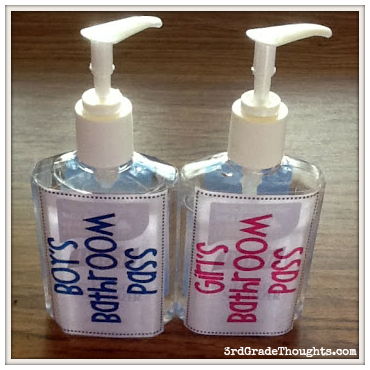
via 3rdGradeThoughts
  • Really ask yourself, is one of  your main worries that they’re going to the bathroom just to escape? If so, ponder what you can do about your classroom environment or practices to make your room a more desirable place to be.
  • For students who are accustomed to total teacher control, they may view this new privilege as a continuation of the “me vs. teachers” game they’ve learned.  If this happens, work with that individual student, reminding him or her about trust.  You may find it necessary to create an individual system for that one student (small check-out sheet, etc), but make sure you do not punish the entire class for the lack of responsibility of just a couple students.

featured image: Sam Breach

8 Tips For Non-Manipulative Classroom Praise

“Praise, like penicillin, must not be administered haphazardly. There are rules and cautions that govern the handling of potent medicines— rules about timing and dosage, cautions about possible allergic reactions.” (Haim Ginott, 1965, p. 39)

Praise Research 

Praise researchers have set up various camps for decades. Some maintain that praise encourages student behavior and motivation, advising teachers to “reward the student with verbal reinforcement when she or he exhibits desired behavior” (Dev, 1997, p 16). 

Others believe that it can damage motivation–and in some cases, even become downright manipulative. Alfie Kohn contends that praise “leads [students] to measure their worth in terms of what will lead us to smile and dole out some more approval” (5 Reasons to Stop Saying Good Job).  They argue that “Praise can create excessive pressure to continue performing well, discourage risk taking, and reduce perceived autonomy.” (Henderlong, J. & Lepper, M.R. “The Effects of Praise on Children’s Intrinsic Motivation: A Review and Synthesis,” p. 776).

Despite these opposing camps, still other researchers examine specific variables of praise that can impact students’ intrinsic motivation both beneficially and detrimentally. In their comprehensive praise review, Henderlong and Lepper conclude, “rather than asking whether praise enhances intrinsic motivation, it is far more useful to ask about the conditions under which this is likely to occur” (The Effects of Praise, p. 791). Some of those conditions include:

  • Sincerity: honest and specific evaluation
  • Performance Attributions: focusing on controllable processes vs. student ability/overly simple tasks
  • Perceived Autonomy: focusing on students’ autonomy vs. our control (finding, in fact, that no praise has a better effect than controlling praise)
  • Competence and Self-Efficacy: focusing on information on performance vs. social comparison
  • Standards & Expectations: focusing on specific praise on appropriately-challenging tasks vs. praise for too-easy or too-difficult tasks

8 Tips

Be mindful of the growth-mindset

Never praise students for what they are right now. Elevate your sights to the vision of where their efforts can take them; if your praise focuses merely on their current abilities, they will be less likely to view that potential for growth in themselves.

“I could tell you worked so hard to figure out that math problem. Way to stick with it even when it was tricky!” instead of “You’re so good at math!”

Be descriptive

Vague statements like “good job” can undermine student motivation because it does not offer concrete support for a student’s effort, nor does it recognize their personal reasons for pursuing the task. On the other hand, a detailed description becomes more useful feedback.

“Nice–when you made eye contact and responded constructively to your group members during that activity, it showed them respect and helped your whole group have a good discussion.” instead of “Good group discussion!”

Make the positive reinforcement more of an observation than explicit praise.

Set the tone of optimism by noticing the good more often than the bad. This helps create a positive atmosphere not only because students know you’re not going to harp on every error, but also because they’ll tend to pay more attention to the good things happening around them, too.

“I notice that Carlos is stacking everyone else’s chairs for them.” 

Connect the praise to genuine principles of respectful relationships.

Really, everything else hinges on this one. As Henderlong and Lepper concluded, “…provided that it is perceived as sincere, praise is likely to enhance intrinsic motivation when attributional messages prevent maladaptive inferences, when autonomy is promoted, when perceived competence and self-efficacy are heightened without undue use of social comparison, and when realistic standards and expectations are conveyed” (The Effects of Praise, p. 791). Nothing else will quite matter if your students sense ulterior motives.

“Wow, when Becca turned her chair around when I was sharing instructions, I could tell she was offering not just her attention, but her respect for my time, because her body language showed it. I really appreciate that.”

Genuinely thank students for their efforts to create a supportive classroom environment

They should know that you understand that it’s not easy to bring 25+ people together in a cooperative, positive, and safe learning environment every day. Give them the tools to help by verbalizing the kinds of choices that support learning.  Express your appreciation for those efforts frequently, reminding them that we’re all in this together!

“When Johnny was sharing his story, I saw Ashley put down her papers and look up at him. It’s not easy for anyone to get up and share, so thank you for helping Johnny feel more comfortable with sharing with such an attentive and respectful audience!” 

Don’t just use positive reinforcement as a misbehavior redirect

Notice and point out times when the entire class is pitching in to help the classroom run smoothly, and explain the difference you can feel–and ask them if they can feel it, too!

“During that transition, everyone put away the math cubes and moved back to their desks for wrap up immediately! I love that we have plenty of time to discuss our math noticings now–thank you for helping our class run smoothly!” 

Notice everyone

Seriously. Use a class list on a clipboard and tally off names if you need to. Otherwise, you and your students both know you’re going to wind up primarily noticing the same 5 line-of-sight people every day.

Get rid of tangible extrinsic rewards that often accompany praise

These devalue the positive attention given because students are less likely to internalize the value of the behavior or task for its own sake.  Keep close tabs on your extrinsic rewards in general, and always be willing to ask yourself the tough questions.

Featured Image: fs999