CVC Easter Eggs

Last week, I shared some fun ways to use Easter eggs in your classroom. Today I have one more idea you can use! 

If you have students who are learning consonant-vowel-consonant (CVC) words, this activity would be perfect for your kiddos. Using the downloadable file below, students can practice reading and recognizing various CVC words.

There are two pages to the file: the first is the student worksheet, and the second is the teacher page. Teachers, cut out the word strips on the second page, and put each strip into an Easter egg. Give each student a set of eggs with the word strips in them. As they open each egg, they can read the word strip, then glue it on the worksheet under the corresponding picture. 

This download is for personal or classroom use only. Do not resell, repost, or claim as your own. 

Using Easter Eggs to Teach

Kids, especially younger ones, love hands-on activities. The movement feels like play time, and also helps build important neural pathways and connections. There are also benefits for increasing hand-eye coordination as students manipulate objects.

In the weeks leading up to Easter, I love to use plastic Easter eggs as manipulatives and learning tools. There are so many things you can do with them to make learning fun and engaging! The activities listed below are mostly geared toward preschool or kindergarten aged kiddos, but Iโ€™m sure older kids would enjoy them as well.ย 

  • Put rice or beans into eggs to make music shakers. Be sure to tape the eggs closed so you donโ€™t end up with rice or beans all over your classroom!
  • Add eggs to a sensory bin for students to find.
  • Use eggs as a measuring toolโ€“ how many eggs tall is each student? How many eggs wide is their desk? How many eggs would it take to measure from one side of the classroom to the other? *For older kids, you could then have them measure the egg then calculate the actual distance.
  • Have students do a color sort with the eggs. Make it more challenging by hiding eggs around the room for them to find first.
  • Hide eggs around the room. Divide the students into small groups and assign each group a color. Whichever team finds all of their eggs first wins the game.
  • Make a chart with each upper case letter of the alphabet on it. Then, write each lower case letter of the alphabet on small pieces of paper. Put the papers in the eggs, hide the eggs, and have students find them. As they find each egg, they must match it to the correct upper case letter.
  • Inside each egg, put a piece of paper containing whatever it is they are working on learningโ€“ simple math equations, sight words, spelling words, trivia questions, etc. Hide the eggs around the room or in a sensory bin.
  • Put students in small teams. Give each team a container of egg halves. Set a timer and see which team can make the tallest tower from their egg halves in the time given.ย 
  • Students can use eggs to form letters or sight words.
  • Print off two sets of identical Easter egg pictures. Cut them out and have students play memory. You can also hide one set around the room and have them find each egg and find the match in the other set.ย  (see photo below)
  • Using the printed eggs, write a math equation, sight word, spelling word, etc. Students can pick an egg and complete the task on the egg.
  • Easter egg mix & matchโ€“ Print the downloadable file below, then color each egg one color on top, and a second color on the bottom. Give students the cards and a container of egg halves. They can make eggs to match each card. (see photos below)

These activities would be so much fun for younger gradesโ€“ give them a try with your students and let us know how they go! Parents of young children, these would be fun for you to try at home, too!

Play memory with matching eggs.
Print & color each egg card
Students can make eggs to match each card

The Different Ways We Learn

Sight words are such a buzzword in our household right now. And if youโ€™ve had a kindergartener before, you know exactly what Iโ€™m talking about. 

Each day my daughter comes home with new worksheets, readers, and other various activities that have to do with sight words. Her teacher also sends her home with a new set of sight words to play with and master from home each week. Weโ€™ve had a lot of fun learning these words through the games and activities weโ€™ve come up with together.ย 

The way I tend to learn best is repetition, repetition, repetition. If I read the words over and over, say it, spell it, rush through them on flashcards again and again, and then I will never forget the words. My mind has to see the word, deconstruct the word, put the word together again, and then itโ€™s set in there forever. 

Because this is how my mind works best, this was the basis for a lot of the activities I chose to do with my daughter. The more exposure, the better! We were doing so much repetition of the words that I was surprised and frustrated when I started realizing that what we were doing wasnโ€™t sticking. When quizzed on the words, she wasnโ€™t able to recall what the words were.ย 

To be honest, it made me feel like a failure. I have all of this background in teaching and I canโ€™t even figure out how to teach my own child some sight words. 

One night, my husband lovingly stepped in. He took out the sight word flashcards and they started making sentences together using only sight words. They would make a sentence, read it, and then create a new sentence, repeating the process over and over. Eventually, they pulled out the sticky notes and added CVC words like cat and dad. They spent about ten minutes doing this activity and while they were having fun and bonding, I was doubting his ability to get anything to stick beyond their current work. But nevertheless, I let them have their time. 

The next evening we pulled out our sight word Jenga game, and immediately I was shocked. She knew the words! All of them! We had done so many different activities and nothing was working, but suddenly in one day, it all clicked for her. 

I approached my husband about it afterward and he told me he was playing a word game with her in a way that he would learn the new words best. By application. By seeing them as a part of a sentence and reading them together with other words. 

In my mind, this made no sense. How can she even read the words if she hasnโ€™t spent the time memorizing them beforehand? 

But in both of their minds, the path using real-life applications worked. I was trying to lead her down my own road of rote memorization for learning, while she desperately needed real-life application.

The concept that everyone learns in different ways is something I know and was taught how to work with during my undergrad. But when it came to my own child, I just assumed her mind worked the same way mine did. I was giving her varying activities to do, but the process for all of them was the same. Repeat the words over and over and over until eventually, you memorize them. 

After my revelation, I started catering to her learning style better. 

We continually made up sentences with sight words. We read books filled with sight words. We even wrote our own book using sight words! Anytime we were looking at words and sentences on cereal boxes, in grocery stores, etc., we pointed out the sight words and read them together.ย 

More application. Less rote memorization.ย 

It was a great, simple reminder that all minds have different systems and routes for learning. Yes, even our own offspring sometimes. 

And if we can take some time to figure out each individual mind and the route they personally need to take when they are struggling to grasp a concept, it can make all the difference in the world to them. It may even turn them into a little, tiny reader.ย 

Photo by James Wheeler

Sight Word Games For the Early Reader in Your Life

With my oldest in kindergarten this year, sight words have become a big part of our daily life. Sheโ€™s practicing them at school and then we have a list at home that we can work on as well. And as Iโ€™ve written time and time again, โ€œPlay is a childโ€™s work.โ€ So we donโ€™t just buzz through sight word flashcards as fast as we can, we use sight words in our play. Here are a few games weโ€™ve come up with together to help along the way. 

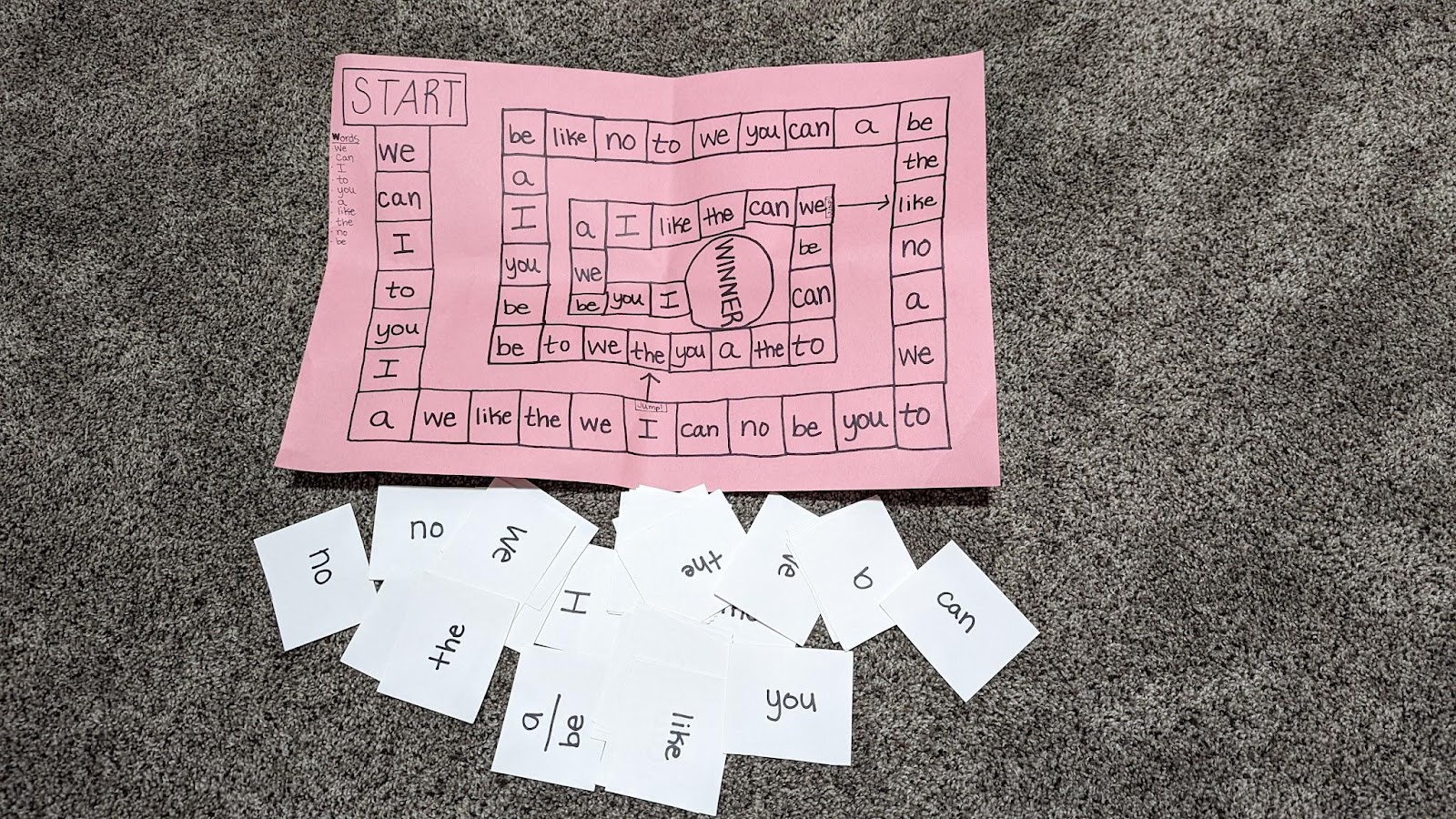
Sight word board game: My daughter and I made this game together in a similar way to how you would play Candyland. There are two ways you can play it- make your own cards with sight words written on them to indicate where your next square is. Or, roll the dice, move forward that many spaces, and read the words as you move. For pieces, we use Bingo tokens, various board game pieces, or small toys. Yes, Skye and Chase help us play this game! If you know, you know!

Sight word Jenga: We bought a few of these tiny tumbling tower sets from Dollar Tree and wrote various sight words on them. Once we pull a brick out, we read the word, and once the tower has tumbled, we take turns making sentences with the words we pulled. We did multiple sets so we could add in more sight words as they learn them in class. I plan to do CVC and CVC-e words someday when sheโ€™s ready for that.ย 

Sight word sentence builder: I bought a pack of sight word flash cards for cheap on Amazon to save me the time and effort of making my own. We use these cards, plus a few index cards with words we decide to add, to create fun sentences. We also use our Jenga blocks for this as well! This one is my daughterโ€™s favorite way to play with sight words!ย 

Sight word seek and find: For this, we use our sight word flashcards, or sometimes Iโ€™ll write them out on sticky notes and use those instead. One of us hides the sight words and then the other one finds them while reading out which word they found.ย Pictured here is your classic “hide it in the Christmas tree” move. The amount of random toys I pull out of our Christmas tree at the end of the holiday from various hide-and-seek games is unreal!

Sight word seek and find + builder: This game is a two-part game! I place sticky notes with letters throughout our family room, then she is required to find the letters and build the sight words out of the letters. This one took some scaffolding. In the beginning, it was just a letter here or there omitted in sight words that she had to find, but as she got better and better at it, she started spelling her own words with less prompting.ย 

Sight word hopscotch: This one can be as intricate or as easy as your time and energy allow. Weโ€™ve done this quickly outside with sidewalk chalk, quickly inside with our flashcards, or intricately with painter’s tape boxes taped out on the floor or full sheets of paper with the words written on them taped to the floor. SO many different ways to do this one! While jumping from square to square, we read the words.ย 

Sight word beanbag toss: This one is a simple one we like to do in addition to the other games weโ€™ve been playing. I simply just lay the flashcards out on the floor and my daughter takes a beanbag (or a soft toy, stuffed animal, etc.), tosses it at a card, and if itโ€™s touching the card she reads the word, then she is handed the card.ย If she doesn’t read the word correctly, she tries again!


Not only are these sight word games building awareness of words, but they are also utilizing fine and gross motor skills, moving around the room, and using, deconstructing, and building these words in ways they havenโ€™t before. Learning sight words isnโ€™t reading. Itโ€™s memorizing. And play is a childโ€™s work, so in order to work through memorizing these words, they must play. 

What sight word games would you add to this list?