Math Manipulatives: More Than Just A Counting Tool

This one’s for you, preschool and early elementary grade teachers! I’m sure most of you have some sort of math manipulative or counting manipulative in your classroom. Manipulatives are a great way to teach math concepts to younger students– they provide a hands-on experience as students learn. As I’ve mentioned before, the more senses that can be engaged during learning, the better chance you have that the concept will become long-term knowledge. I also love manipulatives because they support fine motor development as their tiny fingers pick up and move pieces around. If you have cubes or another more 3D counter, you might also have them use tongs to pick up the counters and move them, thus encouraging even more fine motor skills to be used.

There are so many ways to use manipulatives in your teaching, beyond simply counting with them. Keep reading to discover some fun ways to incorporate these awesome tools into your teaching!

Color sorting

Sorting is one of the earliest and most basic math skills kids learn. Students can work individually or together to sort counters by color. You can have them sort into piles, provide them with colored paper to put them on, or even provide them with colored cups (or color labeled cups) to put them in. 

Grouping by 5s, 10s, etc.

This one might be best for kindergarten or first grade, as that is when they begin to learn to skip count and group numbers. Have students group their counters into groups of 5, 10, 20, or so on. They can do this by color or just by number groups.

Letter Formation

While this isn’t a math skill, you can still use counters for it. Have students practice forming letters with the counters. They might also enjoy spelling their names, or even practicing their spelling words.

Shape Formation

Preschoolers love shapes! Have them use manipulatives to create various shapes. You might need to start with an outline of a shape on a piece of paper for them to follow/trace, but as they become more confident with their shapes, they can do it on their own.

Math Equations

Using manipulatives to display and solve equations can help visual learners see what the math looks like rather than just looking at numbers on a paper. They can create equations for their peers to solve, too, which creates a great opportunity for team work and cooperative thinking.

Pattern Creation

Patterns are all around us, and are another of the foundational math skills that are taught. Students can use counters to follow a pattern or create their own patterns. They can even start a pattern, then share with a classmate to finish it.

Hiding Game

Keeping in mind the abilities of your students, hide counters around the room. Have students go on a “treasure hunt” to find the counters. You can assign them each a color, give them a certain number of counters to find (each student can find 10, etc.), or even put them into pairs to go hunting together. Kids love these kinds of games– they are moving around getting wiggles out, actively searching for something, and if in teams, working together to find the items. 

While these activities are mostly geared toward younger grades, I don’t think students in older grades would mind if you had them try these out. Kids of all ages love to play while they learn!

Math: Valentine’s Style

Number recognition and basic counting skills are fundamental math skills, and who says they can’t be fun to learn?! In fact, students are more likely to invest in and become engaged in learning these skills if they can connect a happy emotion to the experience.

I’ve put together a couple of fun, engaging Valentine’s Day themed early education math worksheets.

** These free downloads are for personal or classroom use only. Do not resell, repost, or claim as your own. If you’d like to share with others, please refer them to this blog post. **

January Might Be the Longest Month of the Year

January is one of those months that seems to drag on and on and on. There aren’t any big holidays to look forward to, and the weather is usually cold and dreary. As a teacher, inclement weather typically means indoor recess, and depending on your class, that could mean extra chaos. If you need something to keep your kiddos entertained in such an event, look no further! Attached below are two Winter Find & Count worksheets– one in color, and one in black and white– that you are welcome to print off and use in your classroom. (Parents, also please feel free to use in the event that the dreary January days get a little extra long and you need a quiet minute!)

** This resource is strictly for classroom or personal use. Do not resell it, repost it, or claim as your own. **

Number Scavenger Hunt & Match

There are many skills that are learned in early childhood that are the foundation for skills that will be learned as they grow. Learning the alphabet, for example, often comes before letter recognition, learning how to put on a shoe comes before knowing how to tie the shoe, knowing how to count is typically learned before number recognition, and so on. Once those foundational skills have been learned and practiced, it opens the door for the next level of complexity to be learned. 

There are many ways to teach these various skills and strategies. I’ve made a scavenger hunt game that you can play with your child or class as they are learning to recognize numbers. It’s quite simple— you cut out the squares with pictures, hide the pictures, then send a child on a hunt to find them. As they find each square, they can count how many pictures are on the square, then match and glue the picture square next to the corresponding written number. 

If you want to reuse this activity, simply laminate the papers to protect them. You could put velcro dots on the back of each picture square and next to each written number. If you wanted multiple children to participate in this, you could assign them each a number, print off the worksheet on different colors of paper and have them find only their color, or encourage them to work with a partner to find each picture square. 

This printable is free, but please only use for personal or classroom use. This is not intended for resale.

You Can’t Count The Apples In A Seed

Hi! Just me again, saying one thing and doing another. I wrote about my blog schedule just last week and was ready to get right to work on it! But on Monday, I strayed right away from the schedule and wrote about schools opening in the Fall because it felt so relevant and something teachers needed to be reading right now. 

I had every intention to dedicate today to introducing Enneagram types and why it can be important in education, but again, another topic came up that I truly felt compelled to write about. I appreciate that I am not getting any hate emails because I’m not following the set schedule I just gave myself. Thanks for letting my intuition take the lead for now. 

Setting up fun, educational activities for my daughter has been a side job and hobby of mine for about two years now. She’s well trained in sensory bins and being responsible with paint, play dough, scissors, and more. I have also been well trained in when and where activities take place. When I’m making dinner it’s a perfect time for unsupervised activities she knows well and can do independently. When her little brother is napping it’s a great time to pull out something new when I can sit with her and walk her through, and help where needed. 

Usually, I am great at seeing the cues of when she needs something besides TV or her regular toys to entertain her. She gets a certain kind of antsy when I am busy and her brain just needs to think and create. But the other day I was so hyper-focused on what I was doing, I didn’t take the time to give her what she needed. She ended up finding some playdough in her bin of activities I keep organized and brought it to the kitchen table asking if she could play with it. She’s an extremely responsible three-year-old, I know! Within minutes she was bored and asking for something new, while I continued to work and ignore her needs. 

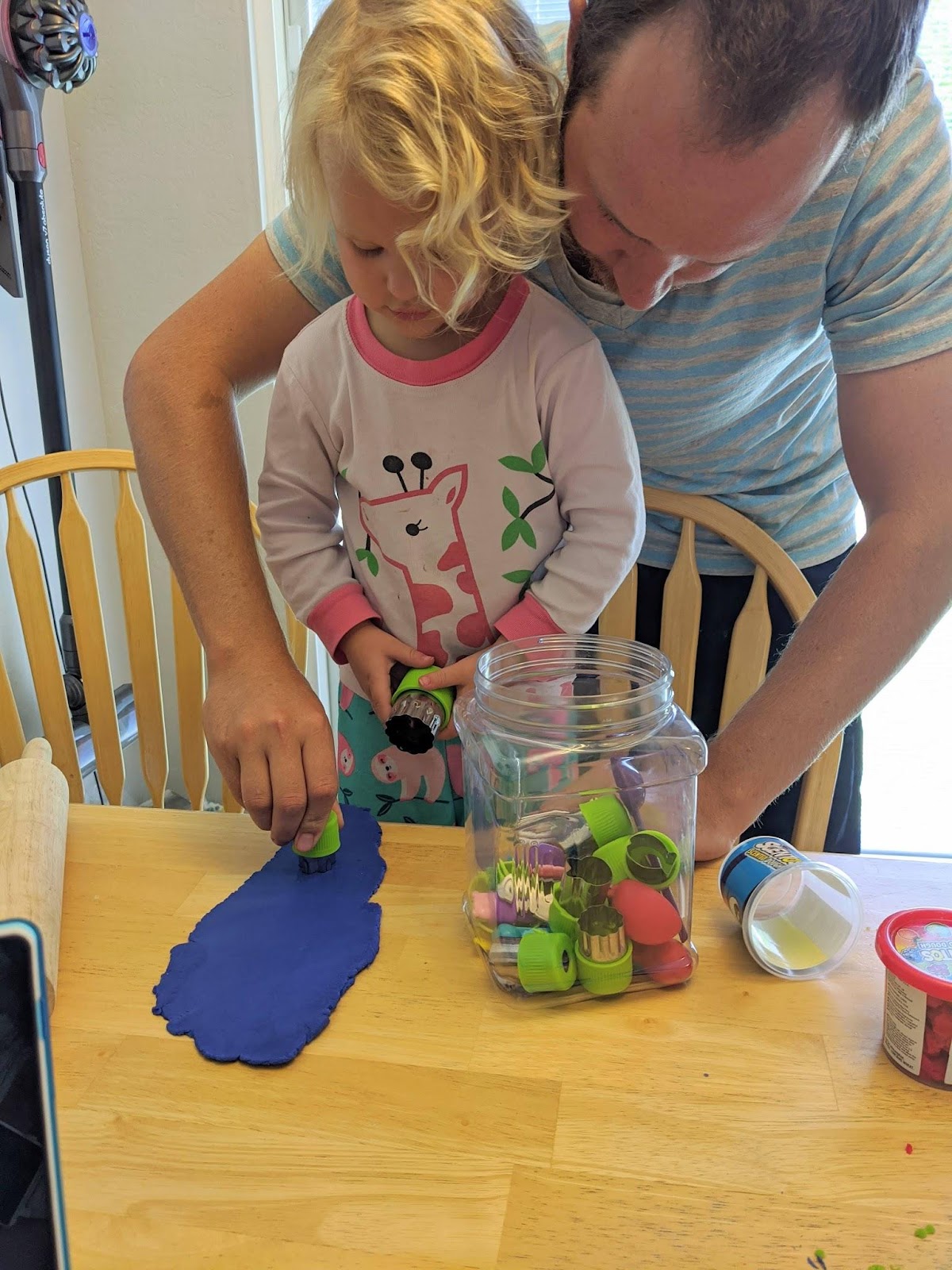
My husband was cleaning the kitchen and watching the interactions unfold, seeing both of our needs. I needed to work and my daughter needed an enriching, fun activity, not just play dough. He walked over with a container full of food picks, food stamps, measuring spoons, and my rolling pin and showed my daughter how to roll the playdough, then stamp the shapes or make the food picks stand up, They scooped the dough with the measuring spoons and packed them in tight to make 3D shapes. Less than 5 minutes of instruction and she was on her way to independent play. 

It made me realize that the activities I’ve set up around my house are maybe teaching more than just my daughter. My husband has seen enough of these setups to know what she needed to succeed, and I’m sure my son is picking up on the rules I’ve set by watching his older sister carry out her painting and sensory bins. I also thought about this quote I’ve seen often as a teacher. 

One seed that we plant as teachers will have lasting effects for generations and generations to come. A positive influence on one child can have lasting impressions on everyone they come in contact with, you never know what great work you are doing. 

This apple quote printable was made for me by Kelsie Housley. If you would like to download the PDF to print and hang in your classroom, the link is below. Do me a favor and leave her a comment of thanks if you downloaded it! I would love to show her our appreciation!